
Government Grants
Top U.S. Government AI Grants You Should Watch in 2026
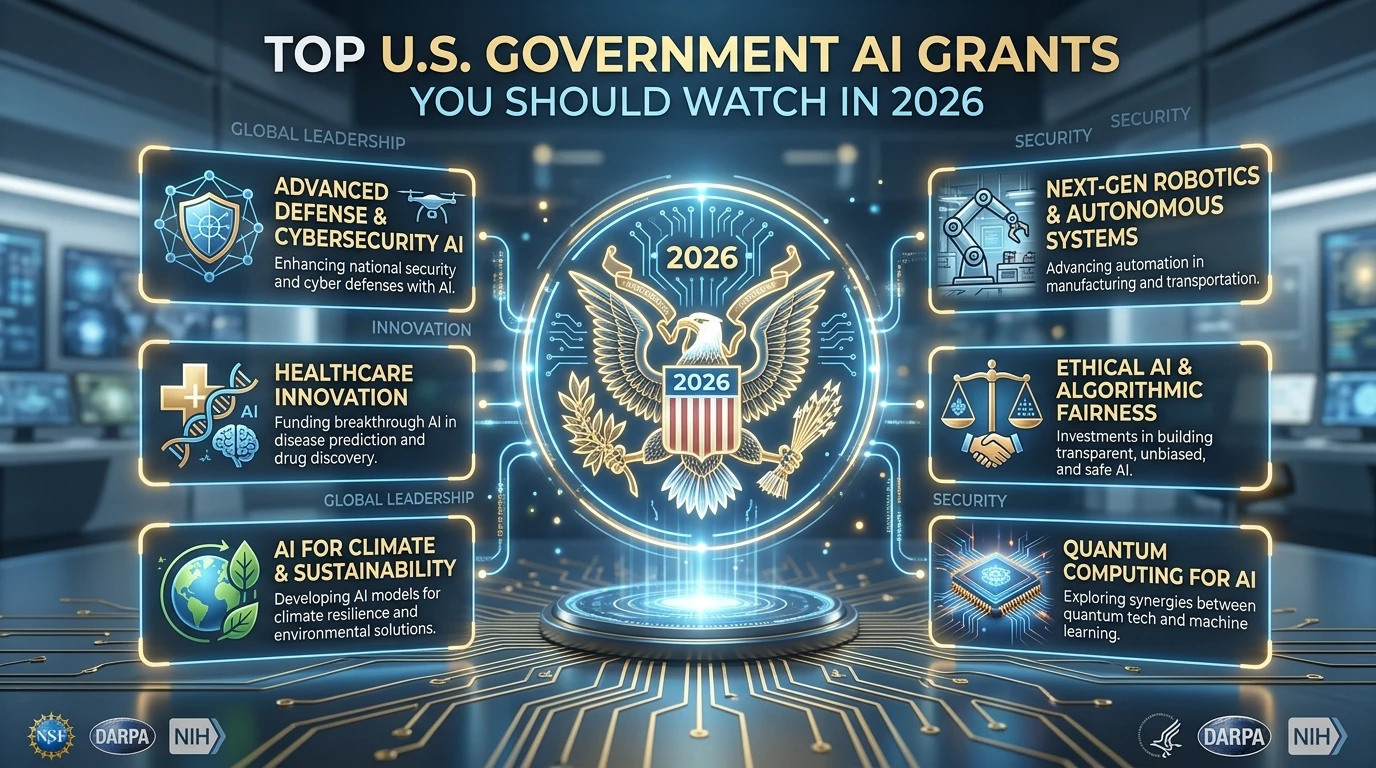
The biggest federal AI funding opportunity in 2026 is NSF’s TechAccess: AI-Ready America program, a $168 million to $224 million initiative funding up to 56 State and Territory Coordination Hubs at $1 million per year. Other key programs include NIST and NSF SBIR/STTR AI awards for small businesses, NSF’s ExpandAI for minority-serving institutions, and SBIR Strategic Breakthrough Awards up to $30 million following the 2026 SBIR reauthorization.
Overview of the Programs
Federal AI funding in 2026 is concentrated across three agencies: the National Science Foundation (NSF), the National Institute of Standards and Technology (NIST), and the Small Business Administration (SBA), often working jointly.
The flagship program is NSF 26-508, TechAccess: AI-Ready America, announced in March 2026 as a joint effort between NSF, the U.S. Department of Labor, USDA’s National Institute of Food and Agriculture, and the SBA. It funds State and Territory Coordination Hubs designed to connect workforce AI training, small business adoption, and local government AI literacy in every state, the District of Columbia, and U.S. territories.
Alongside this, NIST and NSF continue to run AI-focused tracks within the Small Business Innovation Research (SBIR) and Small Business Technology Transfer (STTR) programs. NSF’s ExpandAI program (NSF 23-506) continues to support AI capacity building at historically Black colleges and universities (HBCUs), Hispanic-Serving Institutions (HSIs), and other minority-serving institutions, with roughly $7.5 million allocated for FY 2026.
Eligibility Criteria
Eligibility varies significantly by program, which is one of the most overlooked details among first-time applicants.
For TechAccess: AI-Ready America Coordination Hub awards, NSF describes eligibility as unrestricted, meaning any type of eligible NSF applicant organization, including universities, nonprofits, state agencies, and consortia, may apply. However, the solicitation limits submissions to one proposal per institution.
For SBIR and STTR AI topics through NIST, eligibility generally requires a for-profit small business meeting SBA size standards, primarily owned by U.S. citizens or permanent residents, with prior Phase I awards typically required before applying for Phase II funding.
For ExpandAI, eligibility is restricted to minority-serving institutions, including HBCUs, HSIs, Alaska Native-Serving Institutions, and Predominantly Black Institutions, with two tracks based on institutional AI program maturity.
Benefits and Funding Details
| Program | Funding Amount | Award Type | Best Fit For |
| TechAccess: AI-Ready America (Coordination Hubs) | Up to $1M/year for 3 years, possible 4th year | Standard or Continuing Grant | State agencies, universities, and workforce boards |
| NIST/NSF SBIR Phase II (AI topics) | Up to $400,000 | Cooperative Agreement | Small businesses with completed Phase I |
| SBIR Strategic Breakthrough Awards | Up to $30 million | Late-stage commercialization award | Mature small businesses scaling AI products |
| ExpandAI Track 1 (Capacity Building Pilots) | Up to $400,000 over 2 years | Standard Grant | Early-stage minority-serving institutions |
| ExpandAI Track 2 (Partnerships) | Varies, allocated from the $7.5M FY26 pool | Cooperative Agreement | MSIs are partnering with existing AI Institutes |
This table reflects the most current published figures as of mid-2026 and should be cross-checked against the live solicitation before budgeting an application.
How to Apply
The application path differs by program type, but most follow a similar federal sequence:
- Register or confirm active registration in SAM.gov and Grants.gov.
- Review the specific solicitation number (for example, NSF 26-508) for mandatory components.
- Submit a Letter of Intent (LOI) where required. For TechAccess Round One, letters of intent were due June 16, 2026, with full proposals due July 16, 2026.
- Prepare the full proposal, including budget justification, project narrative, and any required partnership documentation.
- Submit through Research.gov (for NSF) or the relevant agency’s SBIR portal.
Required Documents
Most AI grant applications require a consistent core set of documents, regardless of agency:
- Active SAM.gov registration and Unique Entity Identifier (UEI)
- Project narrative addressing the specific review criteria in the solicitation
- Detailed budget and budget justification
- Letters of collaboration or memoranda of understanding (especially for multi-organization hub proposals)
- Prior award documentation (for SBIR Phase II applicants, proof of Phase I completion)
- Institutional certifications and compliance forms required by the funding agency
Deadlines and Timelines
TechAccess: AI-Ready America will select its 56 hubs across three competition rounds: 10 in Round 1 with proposals due July 16, 2026, 20 in Round 2 with proposals due January 15, 2027, and the remaining 26 in Round 3 due July 1, 2027.
For SBIR programs, deadlines are typically rolling or tied to specific fiscal year solicitation windows, and NIST SBIR Phase I cycles for FY26 have already closed as of this writing, with Phase II eligibility limited to prior Phase I awardees.
Because deadlines and funding caps shift between fiscal years, always confirm current dates directly on Grants.gov or the sponsoring agency’s official solicitation page before building a submission timeline.
Common Mistakes and Rejection Reasons
“Many eligible applicants are denied because documentation requirements are misunderstood rather than because they fail eligibility criteria.”
The most frequent issues seen across federal AI solicitations include:
| Common Mistake | Consequence | How to Avoid It |
| Submitting after the LOI deadline | Application disqualified before review | Calendar LOI and full proposal dates separately |
| Applying for Phase II without a Phase I award | Automatic ineligibility | Confirm award history before drafting |
| Vague alignment with agency priorities | Lower merit review score | Reference specific solicitation language and named initiatives |
| Missing partnership letters for hub-style awards | Proposal flagged as incomplete | Secure MOUs well before the submission window |
| Treating SAM.gov registration as a same-week task | Missed deadline due to registration delays | Begin or renew SAM.gov registration 4-6 weeks early |
“Applying early often matters more than applicants realize when funding is limited.”
Government Authority Notes
TechAccess: AI-Ready America is a coordinated initiative across NSF, the Department of Labor, USDA’s NIFA, and the SBA, reflecting a broader federal trend toward multi-agency AI workforce and adoption programs rather than single-agency grants. The SBIR program itself was reauthorized in February 2026 with enhanced security screening and a new emphasis on technologies with national security relevance, extending the program through 2031.
NIST’s parallel AI Agent Standards Initiative, launched in February 2026, does not itself provide grant funding but is increasingly referenced as a factor in SBIR and research proposal evaluations involving AI agent systems.
What Applicants Should Know Before Applying
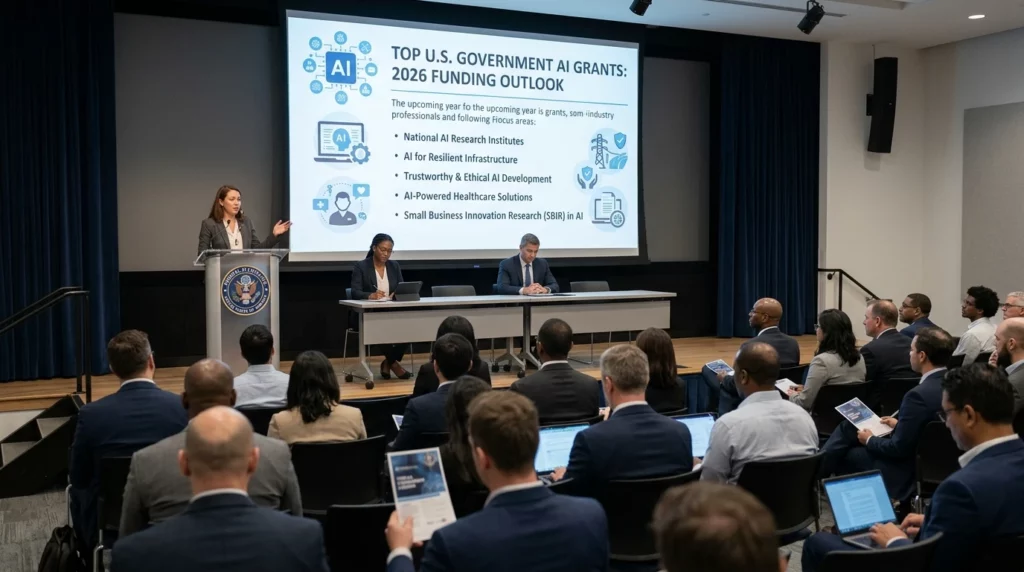
The Coordination Hub structure under TechAccess: AI-Ready America rewards early movers more than the funding totals suggest. Round one funds only 10 hubs, while round two funds 20, meaning institutions that are not ready for the June 2026 letter of intent have a realistic second window in the December 2026 to January 2027 cycle rather than facing a hard cutoff.
A frequent administrative reality with hub-style or consortium awards is that partnership documentation takes longer to assemble than the technical narrative itself. Institutions that wait until the final weeks before a deadline to secure memoranda of understanding from workforce boards, community colleges, or state agencies often find themselves unable to submit a complete application, regardless of the strength of their proposed approach.
For SBIR-track applicants, the Phase I to Phase II pipeline means timing matters across fiscal years, not just within one. An organization that misses a Phase I cycle effectively loses eligibility for the following Phase II cycle as well, since Phase II awards are restricted to recent Phase I recipients.
Cost-sharing requirements are another area of confusion. For the TechAccess Coordination Hub awards, NSF has explicitly stated there is no cost-sharing or matching requirement, which differs from many state-level workforce grants that applicants may be more familiar with.
Is This Program Worth Applying For?
TechAccess: AI-Ready America is best suited for state agencies, public universities, community college systems, and workforce development boards with existing relationships across education, business, and government sectors within their state. Because only one proposal per institution is allowed, organizations should coordinate internally before multiple departments attempt separate submissions.
This program is less suitable for individual researchers, small nonprofits without cross-sector partnerships, or organizations seeking funding for a single research project rather than a coordination role. Those applicants are better matched to NSF’s standard AI research programs, ExpandAI (for minority-serving institutions), or SBIR/STTR tracks.
For small businesses, SBIR AI topics through NIST and NSF remain the most accessible entry point, particularly for companies that can frame their work around AI agent security, evaluation frameworks, or compliance tooling, areas explicitly flagged as priorities following NIST’s AI Agent Standards Initiative.
Organizations that do not fit any of these profiles should consider state-level AI workforce grants, private foundation AI funding (such as the Google.org AI Impact Challenges announced in early 2026), or partnering as a subcontractor under another institution’s hub application rather than leading their own.
Key Takeaways for Applicants
- Most important eligibility point: TechAccess Coordination Hub awards are open to eligible NSF applicant organizations with no cost-sharing requirement, but are limited to one proposal per institution.
- Most important application step: Submit the Letter of Intent on time. Missing the LOI deadline forecloses the full proposal regardless of how strong the narrative is.
- Biggest mistake to avoid: Waiting too long to secure partnership letters and MOUs for hub or consortium-style applications.
- Recommended next action: Identify which round, Round 1 (July 2026) or Round 2 (January 2027), realistically fits your institution’s readiness, and begin partner outreach now regardless of which round you target.
Frequently Asked Questions
What is TechAccess: AI-Ready America?
TechAccess: AI-Ready America is an NSF-led initiative, in partnership with the Department of Labor, USDA’s NIFA, and the SBA, that funds State and Territory Coordination Hubs to expand AI literacy, workforce readiness, and adoption across the United States. It is funded under solicitation NSF 26-508.
Who is eligible for TechAccess Coordination Hub funding?
Eligibility is open to eligible NSF applicant organizations, including universities, state agencies, and nonprofit consortia, with no cost-sharing requirement. Each institution may submit only one proposal.
How do I apply for an AI-related SBIR grant?
Applicants apply through SBIR.gov and the relevant agency’s solicitation on Grants.gov, typically starting with a Phase I feasibility award before becoming eligible for Phase II prototyping funding of up to $400,000.
What documents are required for federal AI grant applications?
Most applications require active SAM.gov registration, a project narrative addressing the solicitation’s review criteria, a detailed budget justification, and, for consortium-style awards, signed letters of collaboration or memoranda of understanding.
Why do federal AI grant applications get rejected?
Common rejection reasons include missed Letter of Intent deadlines, applying for Phase II SBIR funding without a completed Phase I award, incomplete partnership documentation, and proposals that fail to align with the specific priorities named in the solicitation.
Sources:
- NSF TechAccess: AI-Ready America solicitation (NSF 26-508): nsf.gov/funding/opportunities/techaccess-ai-ready-america
- NSF AI-Ready initiative overview: nsf.gov/funding/initiatives/ai-ready
- SBIR/STTR America’s Seed Fund portal: sbir.gov
- Grants.gov (federal application portal): grants.gov
- SAM.gov (entity registration): sam.gov
- NIST SBIR program information: nist.gov/tpo/sbir

Top U.S. Government AI Grants You Should Watch in 2026

VA Closing Cost Assistance for Veterans in 2026: What’s Really Changed This Year?

17 Real Government Grants Americans Are Searching for Right Now (And How to Actually Get Them in 2026)

SNAP Benefits 2026: New Rules, Income Limits & Work Requirements

25 Small Business Grants You Can Apply for in 2026

Top Veterans Financial Assistance Programs 2026

How to Get Free Help Paying Your Electric Bill

LIHEAP 2026 Application Guide for Energy Assistance
-
 Small Business Grants4 months ago
25 Small Business Grants You Can Apply for in 2026
-
 Veterans Assistance1 month ago
Top Veterans Financial Assistance Programs 2026
-
 Utility & Bills Help3 months ago
How to Get Free Help Paying Your Electric Bill
-
 Utility & Bills Help3 months ago
LIHEAP 2026 Application Guide for Energy Assistance
-

 Government Grants3 months ago
How to Apply for Government Grants Online
-

 Disability Benefits4 months ago
How Much Disability Pay Can You Get in 2026?
-
 Government Grants3 months ago
25 Federal Grants That Give Free Money in 2026
-

 Food & EBT / SNAP Benefits2 months ago
5 Key SNAP Policy Changes Coming in 2026 You Should Know
-

 Small Business Grants4 months ago
Women-Owned Business Grants & Funding Sources
-

 Government Grants2 months ago
Top 2026 Grant Opportunities in the USA: What’s Open Now?