
Food & EBT / SNAP Benefits
SNAP Benefits 2026: New Rules, Income Limits & Work Requirements
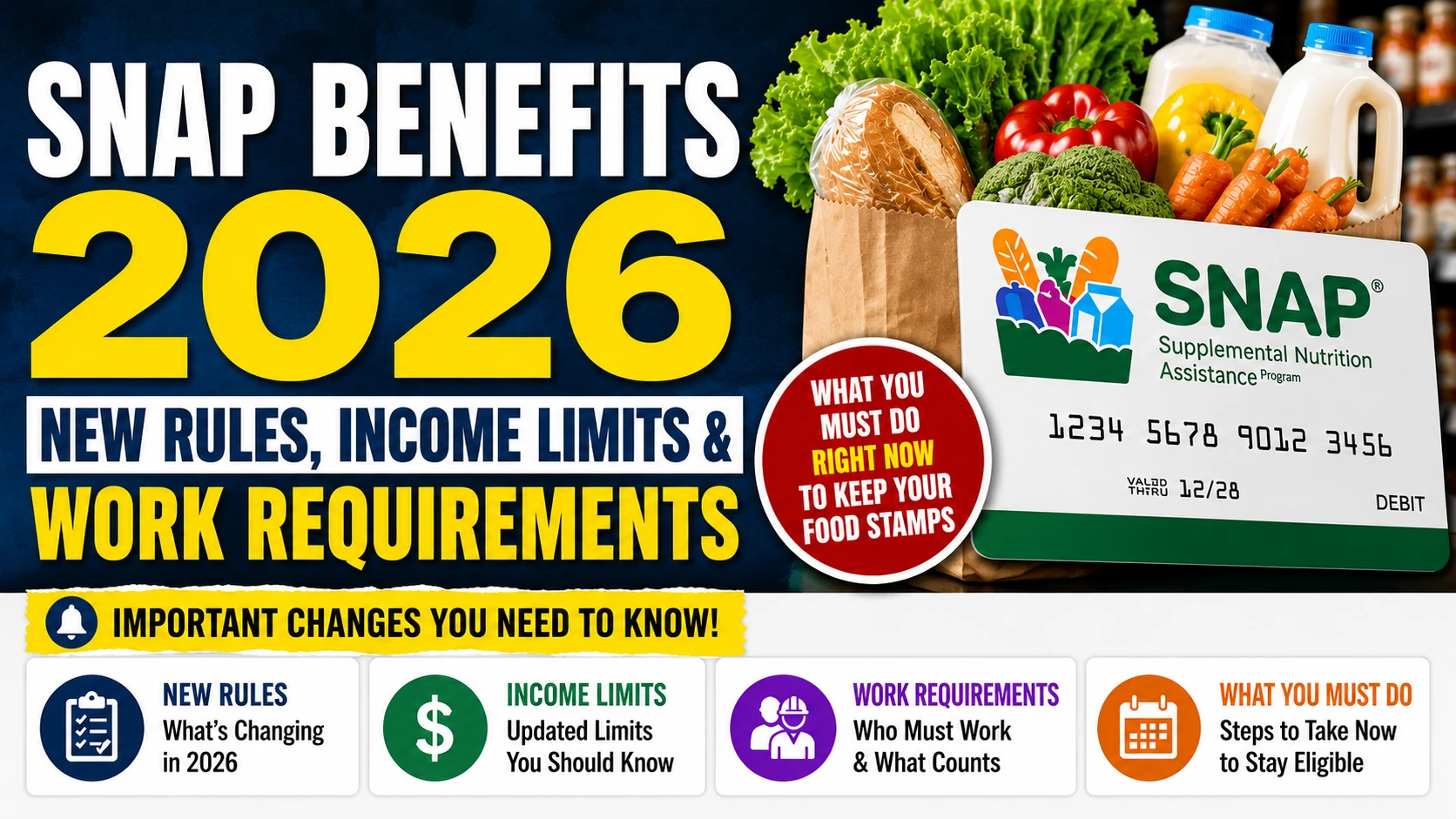
Published: June 2026 | Category: Food & EBT / SNAP Benefits | Reading Time: 9 minutes | UK
URGENT: Major changes to SNAP (food stamps) are now in effect. Over 42 million Americans who receive benefits must meet new requirements or risk losing them. This guide explains every change, who is affected, and exactly what you need to do today to protect your benefits.
What Changed and Why It Matters
If you receive SNAP benefits — or are thinking about applying — 2026 is the most important year for this program in decades.
President Trump signed the “One Big Beautiful Bill Act” into law on July 4, 2025. It made the largest cuts to food assistance in American history, reducing SNAP funding by $186 billion through 2034 according to the Congressional Budget Office.
The changes are not coming — they are already here. States began enforcing new rules starting February 1, 2026, and more enforcement dates are rolling out through May 2026 and beyond.
Here is what changed:
- New work requirements expanded to cover adults up to age 64 (previously only up to 54)
- Several automatic exemptions were eliminated, including for veterans, homeless individuals, and foster youth aging out of care
- Parents with older children lost protection – the exemption now only applies if your child is under age 14 (previously under 18)
- Utility expense calculations changed, which may affect your monthly benefit amount
- Non-citizen eligibility rules were also modified
Bottom line: if you receive SNAP, you need to take action now. If you have never applied, now is still the time — millions of eligible Americans are not enrolled.
The New Work Requirements — Explained Simply
Under the new law, adults aged 18 to 64 who are considered “able-bodied” must meet one of the following every single month to keep their benefits:
| Requirement | Details |
|---|---|
| Work | At least 80 hours per month (about 20 hours/week) |
| Job Training | Participate in an approved employment or training program |
| Community Service / Volunteering | Enough volunteer hours to meet the 80-hour monthly threshold |
What Happens if You Don’t Meet the Requirement?
If you fail to meet the work requirement and cannot prove an exemption, your SNAP benefits will be limited to 3 months within any 3-year period. Starting May 1, 2026, people who have received SNAP for three months and have not proven an exemption will lose their benefits.
What Counts as “Work”?
- A regular job (part-time or full-time)
- Self-employment
- An approved job training or vocational program
- Community service or volunteer work (documented hours)
- Participating in a SNAP Employment and Training (E&T) program through your state
Who Is Exempt From the Work Requirement
Read this section carefully. Many people automatically qualify for an exemption but do not know it. If you qualify, you do not need to meet the 80-hour requirement.
You are likely exempt if you are:
- Age 65 or older
- Physically or mentally unfit for work (a medical condition prevents you from working)
- Pregnant
- Caring for a child under age 14 (note: this was changed from under 18)
- Caring for a disabled household member who needs your attention full-time
- Already participating in a drug/alcohol treatment program
- A student enrolled at least half-time in school or a training program
Groups That LOST Their Exemption Under the New Law
The One Big Beautiful Bill Act eliminated exemptions for several groups who were previously automatically protected:
- Veterans – now subject to work requirements unless they qualify under another exemption
- People experiencing homelessness – no longer automatically exempt
- Youth aging out of foster care – exemption removed
- Adults aged 55–64 – previously exempt, now required to meet work requirements
If you fall into one of these groups, contact your state SNAP office immediately to understand your options.
SNAP Income Limits for 2026 – Full Chart by Family Size
To receive SNAP, your household income must fall below the federal limits. These are the standard federal limits effective October 1, 2025 through September 30, 2026.
Important: Many states have expanded income limits beyond these federal numbers through a policy called Broad-Based Categorical Eligibility (BBCE). Over 40 states participate. Always check your state’s specific limits — you may qualify even if your income exceeds the table below.
Gross Income Limits (130% of Federal Poverty Level)
| Household Size | Monthly Gross Limit | Annual Gross Limit |
|---|---|---|
| 1 person | $1,696 / month | $20,352 / year |
| 2 people | $2,292 / month | $27,504 / year |
| 3 people | $2,888 / month | $34,656 / year |
| 4 people | $3,483 / month | $41,796 / year |
| 5 people | $4,079 / month | $48,948 / year |
| 6 people | $4,675 / month | $56,100 / year |
| 7 people | $5,271 / month | $63,252 / year |
| 8 people | $5,867 / month | $70,404 / year |
| Each additional person | +$596 / month | +$7,152 / year |
Gross income = your total household income BEFORE any deductions (wages, Social Security, unemployment, child support, rental income, etc.)
Net Income Limits (100% of Federal Poverty Level)
| Household Size | Monthly Net Limit |
|---|---|
| 1 person | $1,305 / month |
| 2 people | $1,763 / month |
| 3 people | $2,221 / month |
| 4 people | $2,679 / month |
| 5 people | $3,137 / month |
| Each additional person | +$458 / month |
Net income = gross income AFTER allowable deductions (see below)
What Counts as Income?
SNAP counts these income sources:
- Wages and salaries
- Self-employment income
- Social Security and SSI payments
- Unemployment compensation
- Child support and alimony received
- Rental income
SNAP does NOT count these:
- Tax refunds
- Loans and student financial aid
- Most vendor payments
- Income from people not in your household
Allowable Deductions That Lower Your Counted Income
You may be able to deduct the following from your gross income:
- 20% of earned (work) income
- Standard deduction: $209 for households of 1–3 people (higher for larger households)
- Dependent care costs if needed for work or training
- Medical expenses over $35/month for elderly or disabled members
- Excess shelter costs (housing costs exceeding 50% of net income after other deductions, capped at $744/month for most households)
Maximum Monthly SNAP Benefit Amounts for 2026
These are the maximum benefits a household can receive if they have zero income. Most households receive less, based on their actual income.
| Household Size | Maximum Monthly Benefit (48 states + DC) |
|---|---|
| 1 person | $298 / month |
| 2 people | $549 / month |
| 3 people | $787 / month |
| 4 people | $994 / month |
| 5 people | $1,182 / month |
| 6 people | $1,419 / month |
| 7 people | $1,568 / month |
| 8 people | $1,793 / month |
| Each additional person | +$225 / month |
Note: Alaska, Hawaii, Guam, and the U.S. Virgin Islands have significantly higher benefit amounts. A family of four in Alaska can receive up to $1,995/month. In Hawaii, up to $1,689/month.
How to Calculate Your Exact Benefit
Here is a real-world example so you can estimate your own benefit.
Example family: 3 people, one adult working part-time earning $1,400/month, paying $900/month in rent and utilities.
Step 1 — Gross Income: $1,400
Step 2 — Earned Income Deduction (20%): $1,400 × 20% = $280 deducted → Adjusted income: $1,120
Step 3 — Standard Deduction: Subtract $209 → Net income: $911
Step 4 — Shelter Deduction: Housing costs ($900) exceed 50% of net income (50% of $911 = $455.50), so excess shelter = $900 – $455.50 = $444.50, which can be deducted → Final net income: $911 – $444.50 = $466.50
Step 5 — 30% Contribution: $466.50 × 30% = $140
Step 6 — Monthly Benefit: Maximum for 3 people ($787) minus contribution ($140) = $647/month
This family would receive approximately $647 per month on their EBT card for groceries.
Step-by-Step: What You Must Do RIGHT NOW
Whether you currently receive SNAP or are applying for the first time, here is exactly what to do:
If You Currently Receive SNAP Benefits:
Step 1: Check if you have a work requirement Log in to your state’s benefits portal and check your case status. If you are between ages 18–64 and not automatically exempt, you are required to meet the 80-hour monthly work requirement.
Step 2: Gather proof of work or exemption Collect documents such as:
- Pay stubs (showing your hours worked)
- A letter from your employer
- Volunteer hour logs signed by the organization
- School enrollment verification
- Medical documentation (if claiming health-related exemption)
Step 3: Update your contact information Make sure your state SNAP office has your current address, phone number, and email. Critical notices are being mailed — if you miss them, you could lose benefits without warning.
Step 4: Submit documentation before your next renewal Do not wait. Submit proof proactively. If your renewal is coming up, contact your caseworker now.
Step 5: Set up alerts Enable text or email alerts through your state’s benefits portal so you never miss a deadline.
If You Are Applying for the First Time:
Step 1: Check your eligibility Use the income limit tables above. If your gross household income is below the limit for your household size, you may qualify. If your state has BBCE, the limit may be even higher.
Step 2: Gather your documents You will typically need:
- Photo ID for the adult applying
- Proof of address (utility bill, lease)
- Proof of income (pay stubs, benefit award letters)
- Social Security numbers for household members
- Proof of expenses (rent, utilities, childcare costs)
Step 3: Apply through your state Every state has its own SNAP application portal. Search “[your state] SNAP application” to find the official site. You can also apply in person at your local Department of Social Services.
Step 4: Track your application After submitting, you should receive a decision within 30 days. If you are in a crisis situation with very low or no income, ask about expedited SNAP — you may receive benefits within 7 days.
Frequently Asked Questions
Q: I am 58 years old and have been receiving SNAP for years. Do the new rules affect me?
Yes. The One Big Beautiful Bill raised the work requirement age from 54 to 64. Adults aged 55–64 who were previously exempt are now required to meet the 80-hour monthly requirement unless they qualify under another exemption (such as a medical condition or caregiving for a child under 14).
Q: I am a veteran. Am I still exempt from work requirements?
Not automatically. The new law removed the automatic exemption for veterans. However, if you have a service-connected disability or another qualifying condition, you may still be exempt. Contact your state SNAP office to document your situation.
Q: My income varies month to month. Will I still qualify?
SNAP looks at your income during the certification period. If your income fluctuates, report the changes to your caseworker. Seasonal or irregular income is evaluated based on what you expect to receive during the benefit period.
Q: I am applying for the first time. How long does it take?
Most applications are processed within 30 days. If your household has very little income or no income, you may qualify for expedited benefits within 7 calendar days. Ask specifically about this when you apply.
Q: I lost my job last month. Can I still get SNAP?
Yes — job loss is one of the most common reasons people apply for SNAP. Your income is calculated based on current circumstances. Apply immediately. You may also qualify for expedited processing.
Q: What if my state has different rules?
SNAP is a federal program, but states administer it and have flexibility in some areas. Over 40 states have expanded income limits. Contact your state SNAP agency or visit your state’s official benefits website for state-specific rules.
Q: What happens if I miss a deadline to submit my work documentation?
If you miss a deadline, you may lose your benefits. However, you can typically reapply immediately. Contact your caseworker as soon as possible — some states have a grace period or appeals process.
Q: Can I get SNAP if I am working?
Yes. Most SNAP recipients are in working households. As long as your income falls within the limits, working does not disqualify you — and having earned income actually gives you the 20% earned income deduction that lowers your countable income.
Summary: Key Numbers to Remember
| Item | Amount |
|---|---|
| Work requirement | 80 hours/month (about 20 hrs/week) |
| Maximum benefit, 1 person | $298/month |
| Maximum benefit, family of 4 | $994/month |
| Gross income limit, family of 4 | $3,483/month |
| Asset limit (most households) | $3,000 |
| Minimum monthly benefit | $24 |
Official Resources
- USDA Food and Nutrition Administration (SNAP): fns.usda.gov/snap
- Benefits.gov (find your state’s application): benefits.gov
- National SNAP hotline: Call 211 (United Way helpline) and ask about food assistance in your area
Sources: USDA Food and Nutrition Administration, Congressional Budget Office, Center on Budget and Policy Priorities, Center for Law and Social Policy. This article is for informational purposes only. Rules vary by state. Contact your local SNAP office for guidance specific to your situation.
Was this article helpful? Share it with someone who needs it. Millions of Americans are unaware of these changes and millions more who qualify for SNAP have never applied.

Top States Providing Financial Relief and Emergency Cash Assistance in 2026

Section 811 Housing Assistance 2026: What Disabled Adults Need to Know

Top U.S. Government AI Grants You Should Watch in 2026

VA Closing Cost Assistance for Veterans in 2026: What’s Really Changed This Year?

Fast Food Places That Accept EBT Cards (Full List)

25 Small Business Grants You Can Apply for in 2026

Affordable Housing and Rental Assistance Programs for Texas Single Moms

Most Commonly Approved Government Grant Applications
-
 Food & EBT / SNAP Benefits5 months ago
Fast Food Places That Accept EBT Cards (Full List)
-
 Small Business Grants5 months ago
25 Small Business Grants You Can Apply for in 2026
-
 Single Mothers Benefits3 months ago
Affordable Housing and Rental Assistance Programs for Texas Single Moms
-
 Government Grants5 months ago
Most Commonly Approved Government Grant Applications
-

 Veterans Assistance3 months ago
Top Veterans Financial Assistance Programs 2026
-

 Utility & Bills Help5 months ago
LIHEAP 2026 Application Guide for Energy Assistance
-

 Utility & Bills Help4 months ago
How to Get Free Help Paying Your Electric Bill
-

 Single Mothers Benefits4 months ago
Trump Tax Plan Stay-at-Home Mom Tax Credit Explained: What the Law Actually Says (2026)
-

 Food & EBT / SNAP Benefits4 months ago
5 Key SNAP Policy Changes Coming in 2026 You Should Know
-

 Government Grants5 months ago
How to Apply for Government Grants Online