
Government Grants
Top U.S. Government AI Grants You Should Watch in 2026
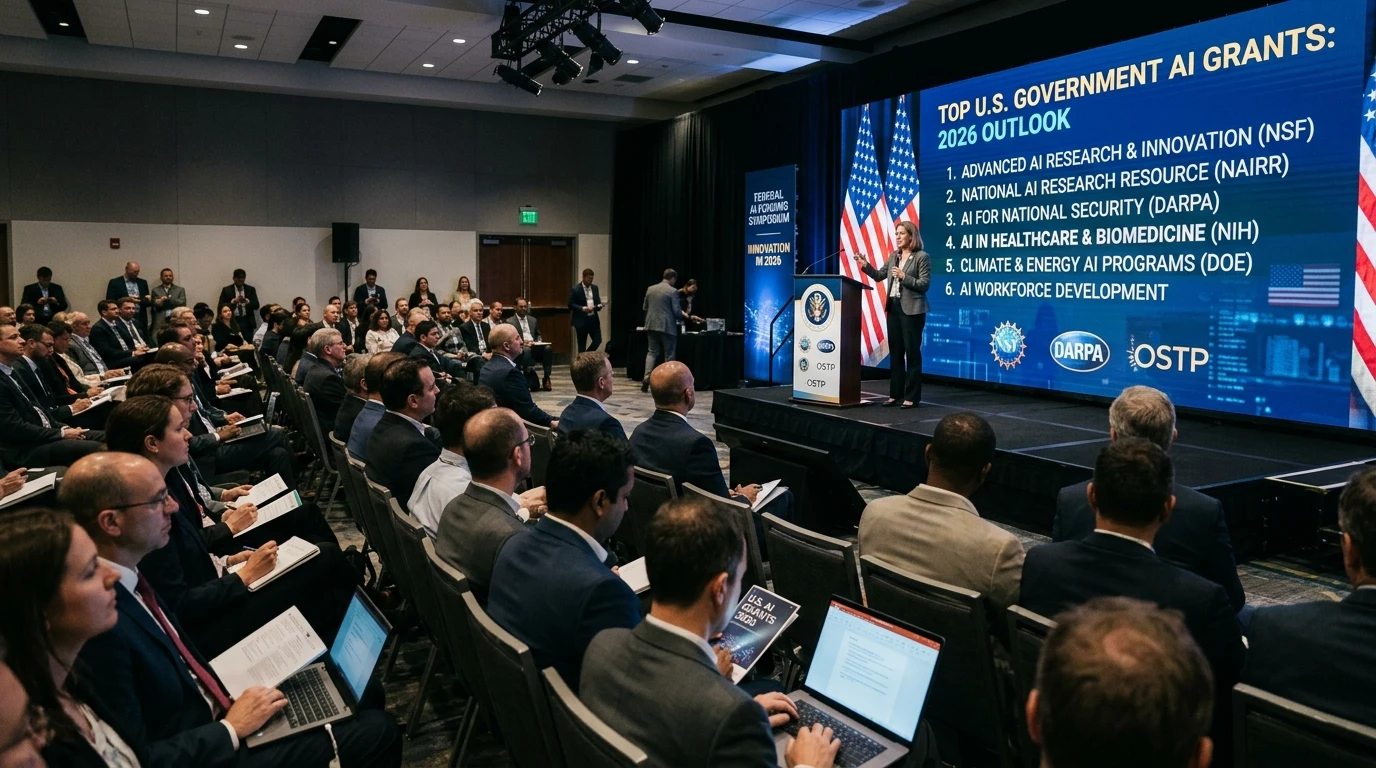
The top U.S. government AI grants in 2026 are led by the U.S. National Science Foundation, National Institutes of Health, U.S. Department of Energy, and Small Business Administration. Major opportunities include the NSF TechAccess: AI-Ready America initiative, NIH Bridge2AI programs, DOE AI-energy funding, and federal SBIR/STTR grants. These programs support startups, universities, nonprofits, local governments, and workforce-development organizations seeking artificial intelligence funding in FY 2025–2026. (NSF – U.S. National Science Foundation)
Federal artificial intelligence funding expanded significantly across FY 2025–2026 as the U.S. government increased investments in workforce readiness, scientific research, healthcare AI, energy systems, and small-business innovation. The White House AI policy agenda, combined with agency-level funding programs, has created new grant opportunities for universities, startups, nonprofits, local governments, and public-private partnerships. (NSF – U.S. National Science Foundation)
Applicants should monitor funding announcements from Grants.gov, agency solicitation portals, and federal research agencies throughout 2026 because many AI programs operate on rolling or multi-round cycles.
Overview of the Top U.S. Government AI Grants in 2026
| Program | Government Agency | Funding Focus | Estimated Funding |
| NSF TechAccess: AI-Ready America | U.S. National Science Foundation | Workforce AI readiness and state AI hubs | Up to $1M annually per hub |
| NSF National AI Research Institutes | U.S. National Science Foundation | Advanced AI research | Up to $20M per institute |
| NIH Bridge2AI | National Institutes of Health | Biomedical AI infrastructure | Multi-million-dollar awards |
| DOE Genesis Mission AI Funding | U.S. Department of Energy | AI for energy and scientific systems | Approximately $293M |
| SBIR/STTR AI Grants | Small Business Administration | Small-business AI innovation | $275K–$1.8M+ |
Funding amounts and deadlines may change during FY 2026.
What Is the NSF TechAccess: AI-Ready America Program?
Definition Block
The NSF TechAccess: AI-Ready America program is a federal initiative launched by the U.S. National Science Foundation in 2026 to improve AI literacy, workforce development, and AI adoption across all U.S. states and territories. The program funds state-level Coordination Hubs that connect businesses, educational institutions, workforce agencies, and local governments. (NSF – U.S. National Science Foundation)
The initiative was developed with support from the U.S. Department of Labor, Small Business Administration, and USDA National Institute of Food and Agriculture. (NSF – U.S. National Science Foundation)
Funding Details
- Up to 56 awards nationwide
- Approximately $1 million annually per Coordination Hub
- Three-year funding structure with possible extension
- Focus on workforce AI training, public-sector AI adoption, and regional AI ecosystems (NSF – U.S. National Science Foundation)
Who Is Eligible?
Eligible applicants may include:
- Universities and colleges
- Nonprofit organizations
- State and territorial agencies
- Workforce-development coalitions
- Public-private partnerships
- Regional economic-development groups
NIH Bridge2AI and Biomedical AI Grants
The National Institutes of Health continues expanding AI funding through Bridge2AI and related biomedical AI initiatives.
These grants focus on:
- Medical data infrastructure
- AI-assisted diagnostics
- Healthcare interoperability
- Public health analytics
- Clinical AI deployment
Research institutions and healthcare nonprofits are primary applicants, although some partnerships include private-sector AI developers. Federal analysis indicates that AI-related research now represents a significant portion of the NIH research portfolio. (arXiv)
Key Eligibility Areas
- Medical schools
- Research universities
- Hospital systems
- Biomedical nonprofits
- Multi-institution collaborations
DOE Artificial Intelligence Grants for Energy and Science
The U.S. Department of Energy expanded AI funding through the DOE Genesis Mission and related AI-energy programs.
These grants support:
- AI for clean energy systems
- Advanced manufacturing
- Grid modernization
- Quantum computing
- Scientific discovery platforms
- Critical minerals and mining technologies
The DOE Genesis Mission includes approximately $293 million in AI-related funding opportunities for FY 2026. (GrantMetric)
Important Policy Note
Many DOE AI programs require:
- National laboratory partnerships
- Cost-sharing agreements
- Technical commercialization plans
- Multi-organization consortium structures
SBIR/STTR AI Grants for Startups and Small Businesses

The federal SBIR/STTR system remains one of the most important AI funding channels for startups in 2026.
Step-by-Step Application Process
- Register on SAM.gov and obtain a Unique Entity Identifier (UEI)
- Identify an AI-related solicitation on Grants.gov
- Prepare technical and commercialization proposals
- Submit through the agency application portal
- Complete agency review and compliance checks
- Respond to clarification or budget requests
Common Participating Agencies
- U.S. National Science Foundation
- U.S. Department of Energy
- Department of Defense
- National Institutes of Health
Typical Funding Levels
| Phase | Typical Funding |
| Phase I | $275,000–$300,000 |
| Phase II | $1M–$1.8M+ |
| Commercialization | Varies by agency |
Required Documents for Federal AI Grants
Most federal AI grant applications require:
- UEI registration documentation
- SAM.gov registration
- Technical proposal narrative
- Budget justification
- Organizational capability statement
- Letters of support
- Data-management plans
- Compliance certifications
- Research security disclosures
Programs involving healthcare or national infrastructure may require additional cybersecurity and ethics compliance documentation.
Deadlines and Timeline Considerations
Time-Sensitive Information (FY 2026)
The NSF TechAccess: AI-Ready America initiative currently lists:
- Letter of Intent deadline: June 16, 2026
- Full proposal deadline: July 16, 2026
- Additional rounds extending into 2027 (NSF – U.S. National Science Foundation)
Many federal AI grants operate on:
- Annual cycles
- Rolling solicitations
- Multi-round competitions
- Agency-specific review calendars
Applicants should monitor official agency portals weekly.
Common Reasons AI Grant Applications Get Rejected
Eligibility and Compliance Issues
Common rejection factors include:
- Incomplete SAM.gov registration
- Missing required forms
- Budget inconsistencies
- Weak commercialization strategy
- Lack of measurable outcomes
- Failure to address agency priorities
- Inadequate cybersecurity planning
- Insufficient partnership structure
Federal reviewers also evaluate whether proposals align with national AI policy priorities and agency missions. (NSF – U.S. National Science Foundation)
Government Authority and Regulatory Notes
Federal AI grants are governed by:
- OMB Uniform Guidance (2 CFR Part 200)
- Agency-specific solicitation rules
- Research security policies
- Federal ethics and data standards
Applicants should review all agency solicitation documents carefully because eligibility and compliance requirements vary between agencies. (NSF – U.S. National Science Foundation)
FAQs
What is the NSF TechAccess: AI-Ready America program?
The NSF TechAccess: AI-Ready America program is a federal initiative that funds state and territorial AI-readiness hubs. It supports AI workforce development, public-sector adoption, and AI literacy programs across the United States. (NSF – U.S. National Science Foundation)
Who is eligible for federal AI grants in 2026?
Eligibility depends on the program. Applicants may include universities, nonprofits, startups, local governments, tribal organizations, healthcare institutions, and small businesses.
How do I apply for U.S. government AI grants?
Most applications begin through Grants.gov or an agency-specific portal. Applicants usually need SAM.gov registration, a UEI number, technical proposals, and budget documentation.
What documents are required for AI grant applications?
Most programs require organizational registration documents, proposal narratives, budgets, compliance certifications, and partnership documentation. Research-focused programs may also require data management and cybersecurity plans.
Why do AI grant applications get rejected?
Applications are commonly rejected because of incomplete documentation, noncompliance with solicitation rules, weak technical plans, or insufficient evidence of public impact and feasibility.
Sources:

How to Apply for Disability Benefits in 2026: Step-by-Step Guide

Apply for Emergency HEAP in New York – Jan 2, 2026 Begins

VA Benefits in 2026: Essential COLA, Top Compensation & Critical Policy Shifts

How HUD’s 2026 Strategy Is Breaking Down Barriers to Affordable Housing

25 Small Business Grants You Can Apply for in 2026

Top Veterans Financial Assistance Programs 2026

How to Get Free Help Paying Your Electric Bill

LIHEAP 2026 Application Guide for Energy Assistance
-
 Small Business Grants5 months ago
25 Small Business Grants You Can Apply for in 2026
-
 Veterans Assistance5 months ago
Top Veterans Financial Assistance Programs 2026
-
 Utility & Bills Help5 months ago
How to Get Free Help Paying Your Electric Bill
-
 Utility & Bills Help5 months ago
LIHEAP 2026 Application Guide for Energy Assistance
-

 Government Grants5 months ago
25 Federal Grants That Give Free Money in 2026
-

 Government Grants5 months ago
How to Apply for Government Grants Online
-

 Disability Benefits5 months ago
How Much Disability Pay Can You Get in 2026?
-

 Small Business Grants5 months ago
Women-Owned Business Grants & Funding Sources
-

 Food & EBT / SNAP Benefits7 months ago
5 Key SNAP Policy Changes Coming in 2026 You Should Know
-

 Veterans Assistance5 months ago
VA Loan Updates: What’s New in 2026