
Emergency Cash Assistance
Emergency Cash Assistance Programs You Can Access Right Now in the USA
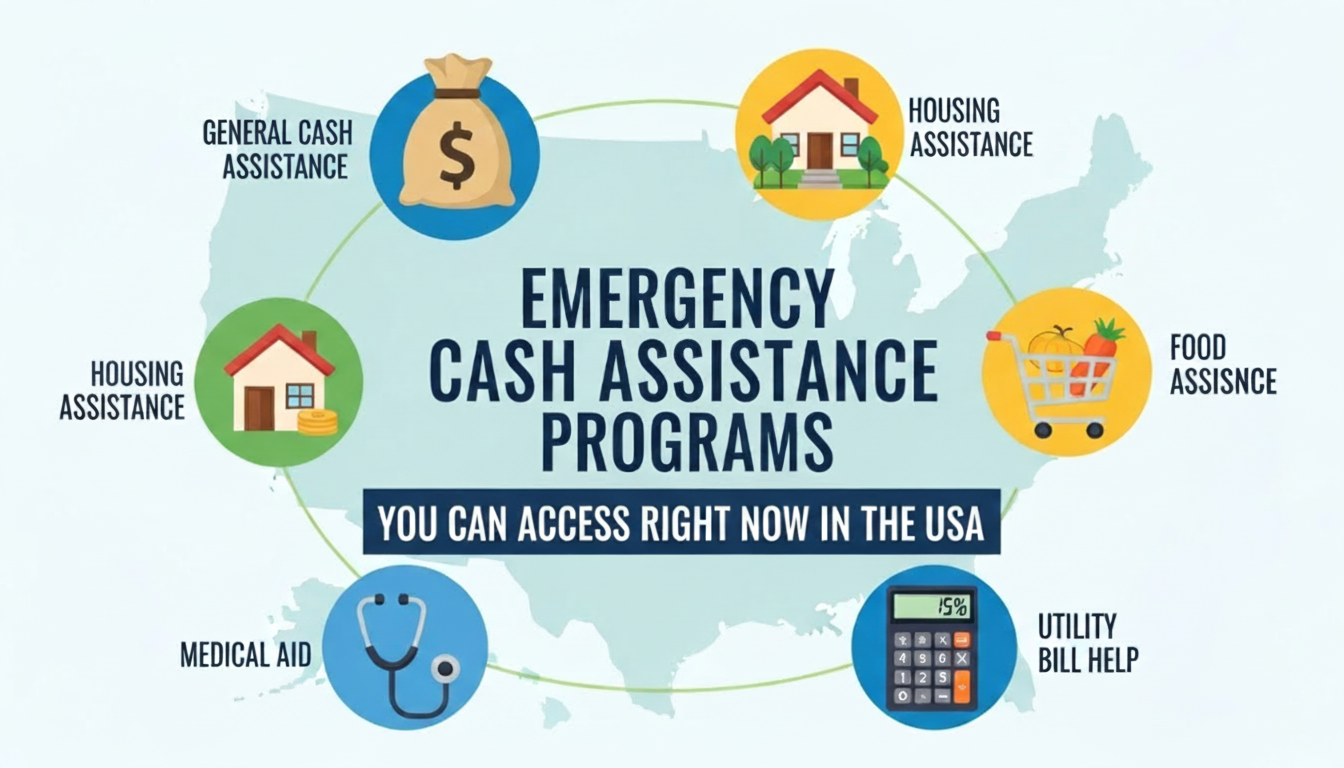
When households face sudden income loss, natural disasters, or urgent living expenses, emergency cash assistance programs serve as a critical financial backstop. These programs are administered at the federal, state, and local levels and are designed to deliver direct monetary aid, not loans, to eligible individuals, families, nonprofits, and, in some cases, small entities.
This guide provides a fact-checked, policy-accurate overview of the legitimate emergency cash assistance programs currently available in the United States, with clear explanations of who qualifies, how much assistance is available, and how to apply. Programs listed here are ongoing or activated based on need, not expired pandemic-era initiatives.
What Counts as “Emergency Cash Assistance”?
In federal and state policy terms, emergency cash assistance refers to:
- Direct cash payments or time-limited monetary benefits
- Issued to address immediate hardship (income loss, disaster, housing instability)
- Not required to be repaid
- Administered through statutory programs, not ad-hoc giveaways
This distinguishes cash aid from in-kind benefits (such as food or housing vouchers), though some programs combine both.
Federal Emergency Cash Assistance Programs
1. Temporary Assistance for Needy Families (TANF)
Agency: U.S. Department of Health and Human Services (HHS)
Administered by: State human services agencies
Purpose:
TANF provides short-term cash assistance to low-income families with children experiencing financial crisis.
Who It Serves:
- Families with dependent children
- Pregnant individuals (in many states)
- Extremely low-income households facing emergencies
Key Features:
- Monthly or emergency lump-sum payments
- Amounts and rules vary by state
- Work participation rules may apply after initial aid
Funding Amount:
Set by states; typically several hundred dollars per month or a one-time emergency payment.
How to Apply:
Apply through your state or county TANF office (often part of the Department of Human Services).
Editorial note: TANF remains one of the only federally authorized cash welfare programs still operating nationwide.
2. Supplemental Security Income (SSI) – Emergency & Immediate Payments
Agency: Social Security Administration (SSA)
Purpose:
SSI provides cash assistance to elderly, blind, or disabled individuals with very limited income. In emergencies, expedited or presumptive payments may be issued.
Who Is Eligible:
- Age 65+ or certified disability
- Limited income and assets
- U.S. citizen or qualifying non-citizen
Emergency Feature:
SSA may issue immediate payments while full eligibility is being finalized.
How to Apply:
Through SSA offices or official SSA channels.
3. FEMA Individuals and Households Program (IHP)
Agency: Federal Emergency Management Agency (FEMA)
Triggered By:
Presidentially declared disasters
Purpose:
Provides direct cash assistance for disaster-related expenses not covered by insurance.
Eligible Expenses Include:
- Temporary housing
- Home repairs
- Medical, childcare, or funeral costs
Funding Amount:
Capped annually (adjusted each fiscal year).
How to Apply:
After a disaster declaration, apply through FEMA’s disaster assistance system.
Time-sensitive: Only available in declared disaster areas and within FEMA’s application window.
4. Low Income Home Energy Assistance Program (LIHEAP) – Cash Crisis Benefits
Agency: HHS (administered by states)
Purpose:
Provides emergency cash assistance to prevent utility shutoffs or restore essential energy services.
Who Qualifies:
- Low-income households
- Priority for seniors, disabled individuals, and families with young children
Payment Type:
- Crisis grants paid directly to utility providers (cash-equivalent relief)
State & Local Emergency Cash Assistance Programs

General Emergency Assistance (GEA)
Most states operate General or Emergency Assistance programs separate from TANF.
Common Characteristics:
- One-time cash payments
- Available to adults without children (often excluded from TANF)
- Administered at county or municipal level
Typical Uses:
- Eviction prevention
- Emergency travel
- Essential living expenses
Emergency Rental Assistance (Localized)
While federal pandemic-era funding has largely closed, some states and cities maintain locally funded emergency cash grants for rent arrears.
Important:
Availability is highly localized and subject to annual budgets.
Special Populations & Targeted Aid
Students
- State emergency student aid grants (public colleges)
- Institutional emergency funds (cash stipends)
Nonprofits & Small Entities
- Local stabilization grants
- Disaster recovery micro-grants (post-emergency)
Immigrants & Mixed-Status Families
- Some states and cities offer state-funded cash assistance not tied to federal eligibility rules
Eligibility Snapshot
| Program | Citizenship Required | Income Tested | Cash Payment |
| TANF | Varies by state | Yes | Yes |
| SSI | Yes (with exceptions) | Yes | Yes |
| FEMA IHP | No (household-based) | Partial | Yes |
| LIHEAP | No | Yes | Indirect cash |
| State Emergency Aid | Varies | Yes | Yes |
Required Documents
- Government-issued ID
- Proof of residence
- Income verification or loss of income
- Utility bills, lease, or emergency expense documentation
- Social Security numbers (where applicable)
Common Reasons Applications Are Denied
- Incomplete documentation
- Income above program limits
- Applying outside designated emergency period
- Duplication of benefits
- Residency mismatches
Frequently Asked Questions
Who is eligible for emergency cash assistance?
Eligibility varies by program but generally depends on income level, household size, and documented financial hardship such as job loss, disability, or disaster impact.
How much emergency cash assistance is available?
Amounts vary by program and state and may be issued as a one-time payment or short-term monthly assistance.
How fast can emergency cash assistance be received?
Some emergency and disaster programs issue payments within days, while others take several weeks to process.
What documents are required to apply?
Common requirements include photo ID, proof of residence, income or income loss verification, and documentation of the emergency expense.
Do emergency cash assistance payments have to be repaid?
No. These payments are grants, not loans, unless fraud or overpayment is later identified.


Final Call for LIHEAP 2026: Many States Ending Applications This April

How Startups Can Get SBIR/STTR Funding in 2026

What Single Moms Need to Know About 2026 State Child Tax Credits

Major 2026 SNAP Changes: What CalFresh Recipients Need to Know

25 Small Business Grants You Can Apply for in 2025

Top Veterans Financial Assistance Programs 2025

How to Get Free Help Paying Your Electric Bill

LIHEAP 2025 Application Guide for Energy Assistance
-
 Small Business Grants11 months ago
25 Small Business Grants You Can Apply for in 2025
-
 Veterans Assistance11 months ago
Top Veterans Financial Assistance Programs 2025
-
 Utility & Bills Help11 months ago
How to Get Free Help Paying Your Electric Bill
-
 Utility & Bills Help11 months ago
LIHEAP 2025 Application Guide for Energy Assistance
-

 Food & EBT / SNAP Benefits11 months ago
Fast Food Places That Accept EBT Cards (Full List)
-

 Housing Assistance11 months ago
Apply for Section 8 Housing Vouchers (Updated 2025)
-

 Small Business Grants10 months ago
Women-Owned Business Grants & Funding Sources
-

 Government Grants11 months ago
How to Apply for Government Grants Online
-

 Government Grants11 months ago
25 Federal Grants That Give Free Money in 2025
-

 Disability Benefits11 months ago
How Much Disability Pay Can You Get in 2025?