
Education & Student Grants
USA Scholarships 2026: 50+ Fully Funded Opportunities (Undergraduate, Masters & PhD)
Last Updated: June 2026 | Verified & Research-Backed By UK
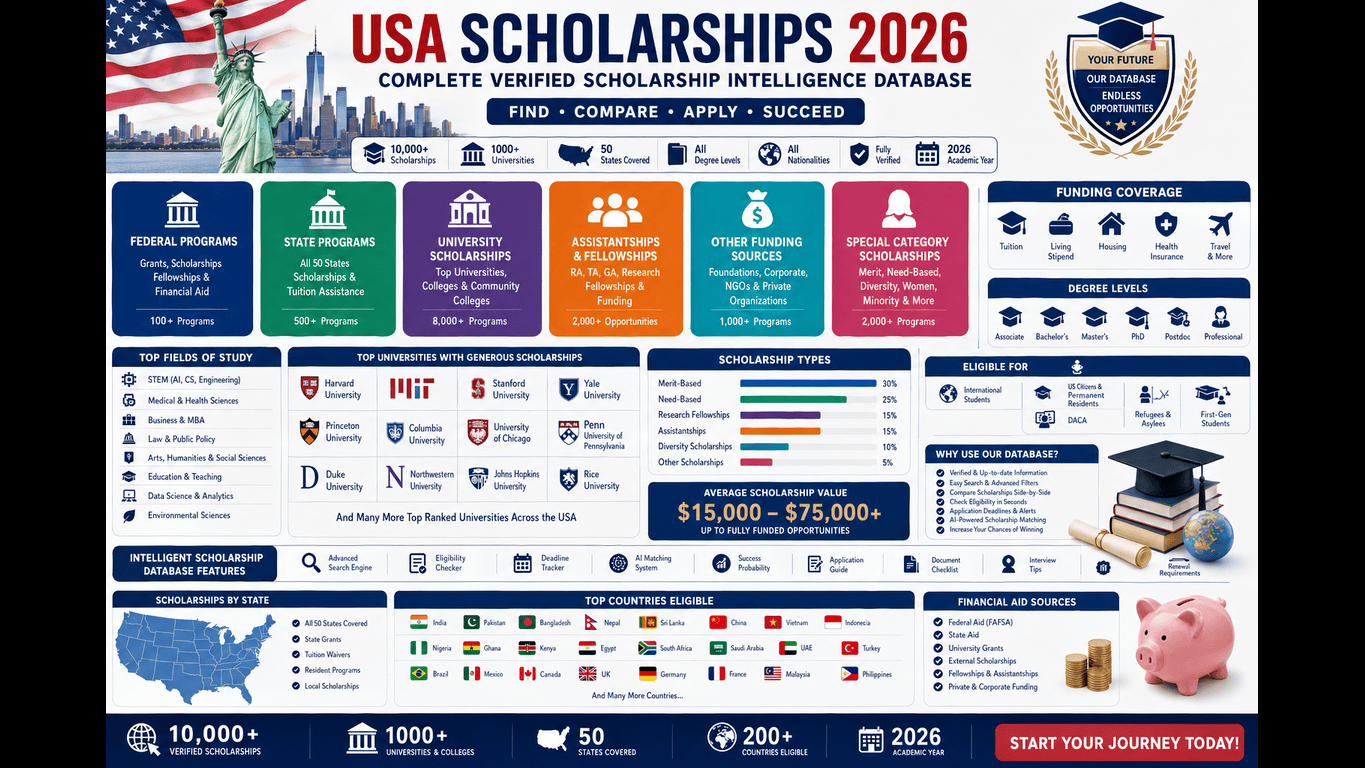
Studying in the United States remains one of the most transformative educational investments in the world — but the cost is a serious barrier for millions of students globally. The good news? The United States offers more scholarship funding than any other country on earth. In 2026 alone, thousands of students will receive billions of dollars in grants, fellowships, and awards from federal programs, elite universities, private foundations, and corporate sponsors.
This guide is the most comprehensive, verified, and up-to-date resource on USA scholarships for 2026. Whether you are a Pakistani student dreaming of Harvard, an Indian applicant targeting a STEM fellowship, or a domestic student looking for need-based aid at a state university, this article covers every major opportunity — with real amounts, real deadlines, and real strategies to help you win.
What you will find in this guide:
- 50+ verified scholarships with funding amounts and deadlines
- Coverage across undergraduate, masters, MBA, PhD, and postdoctoral levels
- Both domestic (US citizens) and international student opportunities
- Insider tips on essays, applications, and winning profiles
- A complete 2026–2027 deadline calendar
Let us begin.
Part 1: The Big Picture — How Scholarship Funding Works in the USA
Before diving into individual scholarships, it helps to understand the funding landscape.
Types of Funding Available
1. Institutional Aid (Most Common) Universities themselves are the largest source of scholarship money. Ivy League schools alone distribute over $1 billion per year in financial aid. Most top private universities practice need-blind admissions for domestic students, and an increasing number — including Harvard, MIT, Princeton, and Yale — are need-blind for international applicants too.
2. Federal Government Programs The U.S. government funds programs like the Fulbright Foreign Student Program, the NSF Graduate Research Fellowship, the Pell Grant, and dozens of agency-specific fellowships.
3. Private Foundations The Gates Foundation, the Rhodes Trust, the Knight-Hennessy program, and hundreds of smaller private foundations distribute billions in annual scholarships.
4. Corporate Scholarships Google, Microsoft, Adobe, Goldman Sachs, and virtually every Fortune 500 company funds scholarship programs — many specifically targeting underrepresented groups.
5. State Programs All 50 U.S. states operate their own scholarship and grant programs for residents. Some of the richest are in California, New York, Texas, Florida, and Michigan.
The Golden Rule: Apply Early and Apply Wide
Scholarship research consistently shows that the students who win funding apply to 10–20 programs, not 2–3. The deadlines cluster around October–January for most major programs, with a significant “second wave” of spring deadlines that most students overlook.
Part 2: Fully Funded Government Scholarships for International
Students
These are the most prestigious and most competitive scholarships available. They cover everything — tuition, living costs, health insurance, airfare, and more.
1. Fulbright Foreign Student Program
The crown jewel of American international education scholarships.
The Fulbright Foreign Student Program is the U.S. government’s flagship international exchange scholarship. It operates in more than 160 countries and brings exceptional graduate students, young professionals, and artists to the United States for advanced study and research.
| Detail | Information |
|---|---|
| Funding Level | Fully Funded |
| Degree Level | Masters & PhD |
| Coverage | Full tuition + living stipend + accommodation + airfare + health insurance |
| Open To | International students (varies by country) |
| Managed By | U.S. Department of State / IIE |
| Acceptance Rate | Approx. 15–20% (varies by country) |
| Typical Deadline | May–October (varies by country) |
| Official Website | foreign.fulbrightoline.org |
What Fulbright Covers:
- Full tuition at a U.S. university
- Monthly living stipend (amount varies by city)
- Round-trip international airfare
- Health insurance
- Settling-in allowance
- Book and supplies allowance
Who Should Apply:
Fulbright is ideal for students with strong academic records, leadership experience, and community engagement. The scholarship values applicants who demonstrate a commitment to returning to their home country and contributing to bilateral relations between their country and the United States. A GPA of 3.5+ is generally expected, and applicants should have clear, well-articulated research or study goals.
Pro Tip:
Fulbright applications are managed by the Fulbright Commission or U.S. Embassy in your home country — not by universities. Start your application with your national Fulbright office, not American universities.
2. Hubert H. Humphrey Fellowship Program
The Humphrey Fellowship is a Fulbright exchange program that brings mid-career professionals from developing countries to the United States for a year of non-degree graduate study and professional development.
| Detail | Information |
|---|---|
| Funding Level | Fully Funded |
| Level | Professional Development (non-degree) |
| Coverage | Full tuition + stipend + airfare + health insurance + professional activities |
| Open To | Mid-career professionals from eligible countries |
| Duration | 10 months |
| Deadline | Varies by country (typically August–November) |
Eligible Fields Include:
Agricultural development, communications, economic development, education, finance, HIV/AIDS prevention, law, natural resources, public administration, public health, technology policy, trafficking in persons prevention, urban planning.
3. Edmund S. Muskie Graduate Fellowship Program (ECA)
Funded by the U.S. Department of State and administered by IREX, the Muskie Fellowship provides graduate study opportunities for citizens of eligible Eurasia and Central Asia countries. If your country is eligible, this is a highly accessible and generous program with relatively lower competition than Fulbright.
| Detail | Information |
|---|---|
| Funding Level | Fully Funded |
| Degree Level | Masters |
| Duration | Up to 2 years |
| Coverage | Tuition + fees + monthly stipend + housing + health insurance + airfare |
Part 3: Elite Private Scholarships — The Most Prestigious Awards
4. Knight-Hennessy Scholars — Stanford University
(One of the largest fully funded graduate scholarships in the world.)
The Knight-Hennessy Scholars program at Stanford University is backed by a $750 million endowment and selects approximately 100 scholars per year from across the globe. It funds any graduate degree at Stanford — including JD, MBA, MD, MS, MA, MFA, DMA, and PhD programs.
| Detail | Information |
|---|---|
| Funding Level | Fully Funded |
| Degree Level | All graduate degrees at Stanford |
| Coverage | Full tuition + fees + living stipend + travel + enrichment funding |
| Number of Awards | ~100 per year |
| Acceptance Rate | ~1% |
| Open To | All nationalities (including U.S. citizens) |
| Application Deadline | October (KHS application); December (Stanford program) |
| Official Website | knight-hennessy.stanford.edu |
What Sets Knight-Hennessy Apart:
Knight-Hennessy does not just fund your degree. Scholars participate in a three-year leadership development program that includes mentoring from Stanford faculty, global travel opportunities, and a powerful alumni network. The selection process focuses on three qualities: independence of thought, purposeful leadership, and a civic mindset.
Note:
The KHS application and your Stanford program application are completely separate. A rejection from KHS does not affect your Stanford admissions decision.
Ideal Profile:
- Strong GPA (3.8+ is typical among selected scholars)
- Demonstrated leadership in your field or community
- Clear vision for how your graduate education will serve a larger purpose
- Research experience or professional achievements appropriate to your field
5. NSF Graduate Research Fellowship Program (NSF GRFP)
(The most prestigious fellowship for STEM graduate students in the United States.)
The NSF Graduate Research Fellowship Program has been running since 1952, making it the oldest fellowship of its kind in the country. It supports U.S. citizens, nationals, and permanent residents pursuing research-based master’s and doctoral degrees in STEM fields. For 2026, the NSF awarded 2,500 fellowships across the country.
| Detail | Information |
|---|---|
| Funding Level | Fully Funded |
| Degree Level | Masters & PhD (research-based) |
| Annual Stipend | $37,000 per year |
| Education Allowance | $16,000 per year (paid to institution for tuition/fees) |
| Duration | 3 years of support over a 5-year period |
| Open To | U.S. citizens, nationals, and permanent residents |
| Eligible Fields | All STEM + STEM education fields |
| Application Deadline | October–November (varies by field) |
| Official Website | nsfgrfp.org |
Key Points:
- Graduate students are limited to only one application, submitted in either year 1 or year 2 of graduate school
- The fellowship is portable — you can transfer it to a different institution
- Over 70% of NSF GRFP fellows complete their doctorates within 11 years
- More than 20 Nobel laureates are NSF GRFP alumni
- Professional degree programs (medical, dental, law, public health) are NOT eligible
What the Selection Committee Looks For:
- Intellectual merit (academic achievement and research potential)
- Broader impacts (how your work benefits society)
- A compelling research plan with clear objectives
6. Paul & Daisy Soros Fellowships for New Americans
(Exclusively for immigrants and children of immigrants)
The Soros Fellowship is one of the most unique and generous scholarships in the United States. It is designed specifically for immigrants and the children of immigrants — honoring the contribution that New Americans have made to U.S. society. Each year, 30 Soros Fellows are selected.
| Detail | Information |
|---|---|
| Award Value | Up to $90,000 total ($25,000 per year for up to 2 years + $20,000 tuition grant) |
| Degree Level | Any U.S. graduate program (law, medicine, business, STEM, humanities) |
| Open To | Immigrants or children of immigrants who are U.S. citizens or permanent residents |
| Number of Awards | 30 per year |
| Acceptance Rate | ~1% |
| Deadline | November |
| Official Website | pdsoros.org |
Eligibility Requirements:
- Must be a New American (immigrant or child of at least one immigrant parent)
- Must be under 31 years of age
- Must be enrolled or planning to enroll in a U.S. graduate program
7. Hertz Foundation Graduate Fellowship
The Hertz Fellowship is one of the most prestigious and least-known STEM fellowships in America. It is specifically designed for the most innovative applied scientists and engineers.
| Detail | Information |
|---|---|
| Award Value | ~$250,000+ total over 5 years ($38,000+ annual stipend) |
| Degree Level | PhD in applied sciences, engineering, mathematics |
| Open To | U.S. citizens and permanent residents |
| Number of Awards | ~15–20 per year |
| Acceptance Rate | <1% (the most competitive STEM fellowship in the US) |
| Deadline | October |
| Official Website | hertzfoundation.org |
Part 4: Ivy League Scholarships 2026
All eight Ivy League universities practice need-based financial aid, and most meet 100% of demonstrated financial need for admitted students — including international students.
8. Harvard University Financial Aid
Harvard operates one of the most generous financial aid programs in the world. Its need-blind admissions policy applies to all applicants, including international students.
| Detail | Information |
|---|---|
| Policy | Need-blind admissions for all applicants (including international) |
| Coverage | 100% of demonstrated financial need |
| Families Earning <$85,000/year | $0 expected contribution |
| Average Aid Package | ~$57,000+ per year |
| % Students Receiving Aid | ~55% of undergraduates |
| Aid Type | Grants only (no loans in aid packages) |
| Official Website | college.harvard.edu/financial-aid |
Harvard’s Income Brackets for Aid:
- Under $85,000/year: Free — $0 expected from family
- $85,000–$150,000/year: 0–10% of income expected
- $150,000–$200,000+: May still qualify for significant aid based on assets and family size
9. Princeton University Financial Aid
Princeton is arguably the most financially generous university in the world per student.
| Detail | Information |
|---|---|
| Policy | Need-blind admissions; meets 100% of demonstrated need |
| Aid Type | Grants only — Princeton eliminated loans from aid packages entirely in 2001 |
| Average Aid Package | Over $57,000 per year |
| Students on Aid | ~62% of undergraduates |
| International Students | Fully eligible for the same need-based aid |
| Special Support | Travel allowances for low-income international students |
| Official Website | financialaid.princeton.edu |
10. Yale University Financial Aid
Yale’s need-based scholarship program covers tuition, housing, meals, and personal expenses.
| Detail | Information |
|---|---|
| Average Need-Based Scholarship | Over $50,000 per year |
| Maximum Award | Over $70,000 per year |
| Policy | Need-blind for U.S. students; need-aware for international students |
| Aid Type | Grants (no loans required) |
| Official Website | finaid.yale.edu |
11. MIT Financial Aid
MIT meets 100% of demonstrated financial need for all admitted undergraduate students.
| Detail | Information |
|---|---|
| Average Aid Package | ~$50,000+ per year |
| Policy | Need-blind for U.S. students |
| Students on Aid | ~57% of undergraduates |
| Graduate Funding | Nearly all PhD students are fully funded through research assistantships, teaching assistantships, or fellowships |
| Official Website | web.mit.edu/sfs |
12. Columbia University Financial Aid
Columbia’s financial aid covers tuition, housing, board, and personal expenses.
| Detail | Information |
|---|---|
| Policy | Need-blind for U.S. students |
| Coverage | Tuition + housing + board + additional academic costs |
| International Students | Eligible for need-based aid and merit fellowships (especially at graduate level) |
| Official Website | financialaid.columbia.edu |
13. Cornell University Financial Aid
Cornell is the only Ivy League university with a fully public college (College of Agriculture and Life Sciences), making it more accessible for state residents.
| Detail | Information |
|---|---|
| Policy | Need-blind; meets 100% of demonstrated need (no loans) |
| National Merit Scholarships | $2,500–$10,000 for National Merit Finalists |
| Additional Merit Awards | Up to $25,000 for exceptional students |
| Official Website | finaid.cornell.edu |
14. Dartmouth College Financial Aid
Dartmouth meets 100% of demonstrated financial need for all admitted students, with allowances for travel included for international students.
| Detail | Information |
|---|---|
| Policy | Need-blind; 100% of need met |
| Aid Type | Grants only (no loans) |
| Official Website | dartmouth.edu/financial-aid |
Part 5: Top Undergraduate Scholarships 2026
Beyond Ivy League aid, here are the most significant named undergraduate scholarships available in 2026.
15. Berea College Full Tuition Scholarship
Every single admitted student receives a full tuition scholarship.
Berea College in Kentucky operates on a unique model — no student pays tuition. Every admitted student receives a full tuition scholarship for four years. In exchange, all students work on campus (10–15 hours per week) through the Labor Program.
| Detail | Information |
|---|---|
| Coverage | Full tuition (valued at ~$30,000+ per year) |
| Open To | U.S. domestic students from low-income families (international students also admitted) |
| Average Family Income of Students | Under $35,000/year |
| Official Website | berea.edu |
16. Clark University Presidential Scholarship
Clark University awards its Presidential Scholarship to the top applicants in each incoming class — approximately five students per year receive this full-ride award.
| Detail | Information |
|---|---|
| Coverage | Full tuition + on-campus room and board (4 years) |
| Number of Awards | ~5 per year |
| Basis | Academic record + leadership potential |
| Open To | All nationalities (regardless of financial need) |
| Official Website | clarku.edu/admissions |
17. Brandeis University WISP Scholarship
The Wien International Scholarship Program at Brandeis University, established in 1958, is one of America’s oldest international undergraduate scholarship programs. It meets the full demonstrated financial need of each recipient.
| Detail | Information |
|---|---|
| Founded | 1958 |
| Coverage | Full demonstrated financial need (tuition + room + board) |
| Basis | Need-based + global citizenship commitment |
| Open To | International students |
| Official Website | brandeis.edu/financialaid |
18. Michigan State University International Tuition Grant
For international undergraduate students who missed the elite school deadlines, MSU’s International Tuition Grant is automatically awarded to high-achieving applicants based on GPA.
| Detail | Information |
|---|---|
| Award Range | Substantial tuition reduction (automatic for qualifying GPA) |
| Basis | Academic merit (GPA 3.5+ strongly recommended) |
| Open To | International undergraduate applicants |
| Advantage | High number of available spots; large public university |
| Official Website | msu.edu |
19. Agnes Scott College SUMMIT Scholarship
Agnes Scott College (women’s college in Atlanta) offers substantial merit scholarships including some full-tuition awards. The college’s SUMMIT curriculum focuses on global leadership.
| Detail | Information |
|---|---|
| Top Award | Full tuition + room and board |
| Open To | Female students (all nationalities) |
| Focus | Global leadership and intercultural competence |
| Official Website | agnesscott.edu |
20. Concordia College International Merit Scholarships
| Detail | Information |
|---|---|
| Award Range | $11,000–$17,000 per year |
| Renewable Annual Scholarship | At least 50% of tuition for select international students |
| Basis | Academic ability + family need + intercultural commitment |
| Open To | International undergraduates |
21. Auburn University International Scholarships
| Detail | Information |
|---|---|
| Award Range | $4,000–$16,000 per year |
| Basis | Academic merit |
| Coverage | Tuition only |
| Open To | International undergraduate and master’s students |
Part 6: Masters Scholarships 2026
22. Schwarzman Scholars — Tsinghua University (China)
While hosted in China, Schwarzman Scholars is a U.S.-funded program (backed by Blackstone’s Stephen Schwarzman) that deserves mention for its global prestige.
| Detail | Information |
|---|---|
| Coverage | Fully funded (tuition + room + board + stipend + travel) |
| Degree | 1-year Masters at Tsinghua University, Beijing |
| Focus | Leadership in a world shaped by China’s growing global influence |
| Number of Awards | ~200 per year |
| Acceptance Rate | ~4% |
| Open To | All nationalities (age 18–28) |
| Deadline | September (US round); November (international round) |
| Official Website | schwarzmanscholars.org |
23. AAUW International Fellowship Program
The American Association of University Women (AAUW) provides fellowships specifically for women pursuing full-time graduate or postdoctoral study in the United States.
| Detail | Information |
|---|---|
| Award Amount | $18,000–$30,000 (master’s/first professional) |
| Postdoctoral Award | $50,000 |
| Open To | Women who are NOT U.S. citizens or permanent residents |
| Degree Level | Master’s, doctoral, and postdoctoral |
| Official Website | aauw.org/resources/programs/fellowships-grants |
24. University of Minnesota Fellowship
| Detail | Information |
|---|---|
| Coverage | Full tuition + living expenses + travel + health insurance |
| Degree Level | Masters |
| Open To | International students |
25. IIE-SRF Fellowship (Institute of International Education)
| Detail | Information |
|---|---|
| Award | Up to $25,000 + individual health insurance |
| Level | Doctoral research (visiting academic appointment) |
| Duration | Up to one year |
| Open To | International scholars |
Part 7: PhD & Doctoral Fellowships 2026
Graduate school in the United States operates differently from other countries. Most PhD programs at top research universities fund their admitted students through a combination of teaching assistantships (TAs), research assistantships (RAs), and fellowships — making the PhD essentially free plus a living stipend.
Standard PhD Funding at Top Universities
At universities like Harvard, MIT, Stanford, Yale, Princeton, Columbia, and Berkeley, nearly all admitted PhD students receive:
- Full tuition waiver
- Annual living stipend: typically $30,000–$50,000 depending on field and location
- Health insurance
- Research funding for conferences and fieldwork
This means that if you are admitted to a PhD program at a top U.S. research university, the question is rarely about scholarships — it is about which funding package is most competitive.
26. Ford Foundation Predoctoral Fellowship
| Detail | Information |
|---|---|
| Annual Stipend | $27,000 |
| Duration | 3 years |
| Open To | U.S. citizens, nationals, and permanent residents from underrepresented groups |
| Focus | Diversity in higher education research |
| Deadline | December |
| Official Website | nationalacademies.org/ford |
27. Gates Cambridge Scholarship (PhD)
While this scholarship funds study at the University of Cambridge (UK), it is primarily awarded to American students (U.S. round) and all international applicants worldwide — making it highly relevant for students with ties to U.S. institutions.
| Detail | Information |
|---|---|
| Maintenance Stipend | ~£21,000 per year (~$26,000+) |
| Coverage | Full tuition + stipend + airfare + visa costs |
| Number of Awards | ~80 per year (25 for U.S. applicants, 55 international) |
| Degree Levels | PhD, MPhil, one- or two-year postgraduate degrees |
| Average GPA of Winners | 3.92 |
| Acceptance Rate | 1.3–5% |
| U.S. Round Deadline | October 2026 |
| International Deadline | December 2026/January 2027 |
| Official Website | gates.cam.ac.uk |
28. Facebook (Meta) Fellowship Program
| Detail | Information |
|---|---|
| Coverage | 2 years of tuition and fees + annual stipend + conference travel |
| Level | PhD (doctoral research) |
| Focus | Computer science, AI, machine learning, AR/VR, and related fields |
| Open To | International students eligible |
| Official Website | research.facebook.com/fellowship |
Part 8: STEM-Specific Scholarships 2026
29. DOE Computational Science Graduate Fellowship (DOE CSGF)
| Detail | Information |
|---|---|
| Annual Stipend | $45,000 |
| Tuition | Full tuition payment |
| Duration | Up to 4 years |
| Open To | U.S. citizens and permanent residents |
| Field | Computational science (where STEM meets computer science) |
| Deadline | January |
30. NDSEG Fellowship (National Defense Science & Engineering Graduate)
| Detail | Information |
|---|---|
| Annual Stipend | $38,400 |
| Coverage | Full tuition + health insurance |
| Duration | 3 years |
| Open To | U.S. citizens in engineering and physical sciences |
| Sponsoring Agency | U.S. Department of Defense |
| Deadline | December |
31. Barry Goldwater Scholarship
The premier undergraduate award for STEM students in the United States.
| Detail | Information |
|---|---|
| Award Value | Up to $7,500 per year |
| Level | Undergraduate (sophomores and juniors) |
| Open To | U.S. citizens, nationals, and permanent residents |
| Focus | Natural sciences, mathematics, and engineering |
| Number of Awards | ~400 per year |
| Deadline | January (through institutional nomination) |
| Official Website | goldwaterscholarship.gov |
32. Udall Scholarship
| Detail | Information |
|---|---|
| Award Value | Up to $7,000 |
| Level | Undergraduate |
| Focus | Environment, tribal policy, and health care for Native Americans |
| Open To | U.S. citizens, nationals, and permanent residents |
| Deadline | March (through institutional nomination) |
33. Department of Energy (DOE) Science Graduate Student Research (SCGSR)
| Detail | Information |
|---|---|
| Award | Supplemental stipend ($3,000/month) + travel |
| Duration | 3–12 months |
| Open To | U.S. citizens pursuing STEM PhDs |
| Benefit | Conduct dissertation research at a national DOE laboratory |
| Deadline | May and November (two annual solicitations) |
Part 9: Scholarships for International Students by Degree Level
Undergraduate International Scholarships — Summary Table
| Scholarship | University | Award Value | Deadline |
|---|---|---|---|
| Harvard Need-Based Aid | Harvard | Up to $75,000/year | Jan 1 |
| Princeton Aid | Princeton | Up to $80,000/year | Jan 1 |
| Yale Aid | Yale | $50,000–$70,000/year | Jan 2 |
| Clark Presidential | Clark | Full tuition + room | Nov 15 |
| Brandeis WISP | Brandeis | Full demonstrated need | Jan 1 |
| MSU Int’l Tuition Grant | Michigan State | Substantial tuition reduction | Rolling |
| Agnes Scott SUMMIT | Agnes Scott | Up to full tuition | Feb 1 |
| Concordia Merit Award | Concordia | $11,000–$17,000/year | Rolling |
| Auburn University Award | Auburn | $4,000–$16,000/year | Rolling |
Masters International Scholarships — Summary Table
| Scholarship | Funder | Award Value | Field | Deadline |
|---|---|---|---|---|
| Fulbright Foreign Student | U.S. State Dept | Fully funded | All fields | Varies by country |
| Knight-Hennessy | Stanford | Fully funded | All Stanford grad degrees | October |
| Schwarzman Scholars | Schwarzman Foundation | Fully funded | Leadership | Sep–Nov |
| AAUW Fellowship | AAUW | $18,000–$30,000 | All fields (women) | Nov 15 |
| Hubert Humphrey | U.S. State Dept | Fully funded | Professional fields | Varies |
| UMinn Fellowship | U of Minnesota | Fully funded | All fields | Varies |
PhD International Scholarships — Summary Table
| Scholarship | Funder | Annual Value | Field | Deadline |
|---|---|---|---|---|
| NSF GRFP | NSF | $37,000 stipend + $16,000 tuition | STEM | Oct–Nov |
| Ford Foundation | Ford Foundation | $27,000 stipend | All fields | December |
| NDSEG | DoD | $38,400 + tuition | Engineering/science | December |
| DOE CSGF | DOE | $45,000 + tuition | Computational science | January |
| Hertz Fellowship | Hertz Foundation | $38,000+ | Applied science & engineering | October |
| Gates Cambridge | Gates Foundation | £21,000 + full tuition | All fields | Oct/Dec |
| Meta Fellowship | Meta | Full tuition + stipend | CS/AI/ML | October |
Part 10: Scholarships for Students from Pakistan, India & South Asia
Pakistani, Indian, Bangladeshi, and Nepali students are among the most active scholarship seekers for U.S. education. Here is what you need to know.
Key Opportunities for Pakistani Students
1. Fulbright Pakistan
The Fulbright program in Pakistan is one of the most active bilateral exchanges in the world. The Pakistan-U.S. Educational Foundation (USEFP) manages the program.
- Master’s and PhD programs at U.S. universities
- Open to Pakistani nationals only
- Deadline: Typically February–April each year
- Website: usefpakistan.org
2. Knight-Hennessy Scholars
Pakistani students are fully eligible and there is no country quota. Multiple Pakistani nationals have won this scholarship.
3. AAUW International Fellowship
Pakistani women pursuing graduate study in the U.S. are fully eligible.
4. University-Specific Scholarships
Many U.S. universities have need-based and merit scholarships open to Pakistani nationals including:
- Harvard (need-blind for all internationals)
- Princeton (need-blind for all internationals)
- MIT (need-blind for U.S. students; strong aid for international PhD students)
- University of Arkansas FIES International Scholarship Fund
Key Opportunities for Indian Students
India sends the largest number of international students to the United States. Key programs include:
- Fulbright-Nehru Fellowship:
Specifically for Indian nationals (masters, doctoral, visiting researchers) - Inlaks Shivdasani Foundation Scholarship:
Supports outstanding young Indians to study at top universities abroad - Knight-Hennessy Scholars:
Open to Indian nationals - NSF-funded university fellowships:
Available at the PhD level through departmental funding
Key Opportunities for Bangladeshi Students
- Fulbright Bangladesh Program:
Managed through the U.S. Embassy in Dhaka - AAUW International Fellowship:
Open to Bangladeshi women - University scholarships at the PhD level
Part 11: F-1 Visa and Scholarship Compatibility
A critical concern for international students is whether a scholarship will support or require a specific visa type.
F-1 Student Visa Compatibility
Most university scholarships and fellowships in the United States are fully compatible with F-1 student visa status. Universities that offer you admission and funding will also issue your I-20 form and assist with your visa application.
Key Points:
- Scholarship awards do NOT negatively affect your F-1 visa application
- Having financial support actually strengthens your visa application (demonstrating funds)
- University financial aid offices routinely issue funding confirmation letters for visa interviews
J-1 Exchange Visitor Visa
Government-funded programs like Fulbright typically use the J-1 visa. This comes with a two-year home country residency requirement, meaning you are expected to return to your home country for at least two years after completing your program before you can apply for an H-1B or permanent residency in the U.S.
DACA Students
Many university scholarships now explicitly include DACA recipients. The Fulbright U.S. Student Program accepts DACA students for domestic programs. Knight-Hennessy accepts DACA students who are enrolled or plan to enroll at Stanford.
Part 12: Federal Aid for U.S. Citizens and Permanent Residents
34. Federal Pell Grant
The largest source of need-based aid for undergraduate U.S. students.
| Detail | Information |
|---|---|
| Award Amount | Up to $7,395 per year (2025–26 academic year) |
| Open To | U.S. citizens and eligible non-citizens |
| Basis | Financial need |
| Renewable | Yes, for up to 12 semesters |
| Application | FAFSA (Free Application for Federal Student Aid) |
| Official Website | studentaid.gov |
35. Federal Supplemental Educational Opportunity Grant (FSEOG)
| Detail | Information |
|---|---|
| Award Amount | $100–$4,000 per year |
| Open To | Undergraduates with exceptional financial need |
| Priority | Pell Grant recipients |
| Application | FAFSA |
36. TEACH Grant (Teacher Education Assistance for College and Higher Education)
| Detail | Information |
|---|---|
| Award Amount | Up to $4,000 per year |
| Open To | Students pursuing teaching careers |
| Service Requirement | Must teach for 4 years in a high-need school |
| Application | FAFSA + TEACH Grant Agreement |
Part 13: State-Level Scholarships — Best Programs by State
California
Cal Grant Program — One of the most generous state aid programs in the nation.
- Cal Grant A: Up to $9,220/year for UC students; $5,642/year for CSU students
- Cal Grant B: Up to $1,648/year (access award for living expenses)
- Open to California residents attending California institutions
- Deadline: March 2 (FAFSA/CADAA deadline)
- Website: csac.ca.gov
California Dream Act Application (CADAA): California allows AB 540 students (undocumented and DACA) to apply for state-funded grants including Cal Grants through the CA Dream Act.
New York
Excelsior Scholarship — Free tuition at SUNY and CUNY for qualifying families.
- Covers full tuition at SUNY and CUNY institutions
- Income limit: Up to $125,000/year household income
- Requires 30 credits/year and living in NY for 4 years after graduation
- Website: hesc.ny.gov
TAP (Tuition Assistance Program) — Up to $5,665/year for NY residents attending NY colleges.
Texas
TEXAS Grant (Toward EXcellence, Access & Success)
- Up to $7,800/year for undergraduate Texas residents
- Must complete Recommended High School Program or Distinguished Achievement Program
Florida
Florida Bright Futures Scholarship
- Florida Academic Scholars Award: 100% of tuition and fees
- Florida Medallion Scholars Award: 75% of tuition and fees
- Requires strong GPA and community service hours
Michigan
Michigan Competitive Scholarship — Up to $1,000/year for MI residents at eligible MI institutions.
Illinois
Illinois Student Assistance Commission (ISAC) Monetary Award Program (MAP)
- Up to $6,200/year for low-income IL residents
Part 14: Corporate Scholarships 2026
37. Google Generation Scholarship
| Detail | Information |
|---|---|
| Award Value | $10,000 per year |
| Open To | Students from underrepresented groups pursuing computer science |
| Level | Undergraduate and graduate |
| Deadline | December |
| Official Website | buildyourfuture.withgoogle.com/scholarships |
38. Microsoft Scholarship Program
| Detail | Information |
|---|---|
| Award Value | Varies ($5,000–$12,000) |
| Focus | Computer science, engineering, and related fields |
| Open To | Underrepresented students (women, minorities, students with disabilities) |
| Deadline | February |
| Official Website | careers.microsoft.com/students |
39. QuestBridge National College Match
| Detail | Information |
|---|---|
| Award Value | Full four-year scholarship (tuition + room + board + books) |
| Open To | High-achieving, low-income U.S. high school seniors |
| Partner Schools | 50+ elite colleges including all Ivies |
| Acceptance Rate | ~4% |
| Deadline | September |
| Official Website | questbridge.org |
QuestBridge is one of the most important scholarship programs for low-income American students. It matches outstanding low-income students with full four-year scholarships at elite partner universities. If you qualify (typically household income below $65,000 for a family of four), this should be your first application.
40. Coca-Cola Scholars Program
| Detail | Information |
|---|---|
| Award Value | $20,000 |
| Number of Awards | 150 per year |
| Open To | U.S. citizens/permanent residents in their senior year of high school |
| Focus | Leadership and community service |
| Deadline | October |
| Official Website | coca-colascholarsfoundation.org |
41. Jack Kent Cooke Foundation College Scholarship
| Detail | Information |
|---|---|
| Award Value | Up to $55,000 per year (the largest private scholarship in the U.S. for high-achieving, low-income students) |
| Open To | U.S. citizens/permanent residents in 12th grade |
| Income Requirement | Household income ≤ $95,000 |
| Deadline | September |
| Official Website | jkcf.org |
Part 15: Diversity & Minority Scholarships
42. Gates Scholarship (The Gates Millennium Scholars Program)
| Detail | Information |
|---|---|
| Coverage | Full cost of attendance for all 4 years of undergrad + graduate school |
| Open To | African American, American Indian/Alaska Native, Asian Pacific Islander, or Hispanic American students |
| GPA Requirement | 3.3+ |
| Income Requirement | Must demonstrate financial need |
| Deadline | January |
| Official Website | thegatesscholarship.org |
43. Ron Brown Scholar Program
| Detail | Information |
|---|---|
| Award Value | $10,000 per year (renewable for 4 years = $40,000 total) |
| Open To | African American students |
| Focus | Academic achievement + community service + leadership |
| Deadline | January |
| Official Website | ronbrown.org |
44. Hispanic Scholarship Fund (HSF)
| Detail | Information |
|---|---|
| Award Range | $500–$5,000 |
| Open To | Hispanic/Latino U.S. citizens and permanent residents |
| Level | Undergraduate and graduate |
| Deadline | February |
| Official Website | hsf.net |
45. American Indian College Fund Scholarships
| Detail | Information |
|---|---|
| Awards | Multiple scholarships ranging from $1,000–$20,000 |
| Open To | Enrolled members of federally recognized tribes |
| Level | Undergraduate, graduate, professional |
| Official Website | collegefund.org |
Part 16: Women’s Scholarships 2026
46. P.E.O. International Peace Scholarship
| Detail | Information |
|---|---|
| Award Amount | Up to $12,500 |
| Open To | International women pursuing graduate study in the U.S. or Canada |
| Requirements | Must be enrolled in accredited institution; not a U.S. or Canadian citizen |
| Deadline | December 15 |
| Official Website | peointernational.org |
47. Zonta International Amelia Earhart Fellowship
| Detail | Information |
|---|---|
| Award Amount | $10,000 |
| Open To | Women pursuing PhDs in aerospace-related sciences and engineering |
| Number of Awards | ~35 per year |
| Deadline | November |
| Official Website | zonta.org |
Part 17: Leadership & Service Scholarships
48. Truman Scholarship
| Detail | Information |
|---|---|
| Award Value | Up to $30,000 for graduate study |
| Open To | U.S. citizens committed to public service careers |
| Level | Undergraduate juniors |
| Number of Awards | ~55–60 per year |
| Deadline | February (through institutional nomination) |
| Official Website | truman.gov |
49. Udall Scholarship (Environment & Tribal Policy)
| Detail | Information |
|---|---|
| Award Value | $7,000 |
| Open To | U.S. students in sophomore or junior year |
| Focus | Environment, or Native American health/tribal policy |
| Deadline | March |
50. DoSomething.org Scholarships
| Detail | Information |
|---|---|
| Award Range | $500–$10,000 |
| Open To | All U.S. residents under 25 |
| Focus | Volunteer and civic engagement projects |
| Frequency | Multiple campaigns throughout the year |
| Official Website | dosomething.org |
Part 18: Transfer Student Scholarships
Many students overlook the strong scholarship opportunities available to community college transfer students.
Key Programs:
- Phi Theta Kappa Scholarship:
For community college students maintaining high GPA; $1,000–$2,500 at many institutions - Jack Kent Cooke Transfer Scholarship:
Up to $55,000/year for community college transfer students (one of the most generous transfer scholarships available) - Stamps Scholarship:
Full ride + enrichment fund of $12,000 at multiple institutions; available for transfer students at select universities - University of California Transfer Pathways:
Various merit scholarships for CC transfers to UC system schools
Part 19: 2026–2027 Scholarship Deadline Calendar
Use this calendar to plan your application timeline. Note that deadlines vary year to year — always verify on the official website.
September–October 2026
| Deadline | Scholarship |
|---|---|
| September (varies) | QuestBridge National College Match |
| September | Schwarzman Scholars (U.S. round) |
| October | Knight-Hennessy Scholars (KHS application) |
| October | Hertz Foundation Fellowship |
| October | Meta Fellowship |
| October | Gates Cambridge (U.S. round) |
| October–November | NSF GRFP (varies by field) |
| October | Coca-Cola Scholars Program |
| October (varies) | NDSEG Fellowship |
| October | Fulbright (varies by country — some May, some Oct) |
November 2026
| Deadline | Scholarship |
|---|---|
| November | Paul & Daisy Soros Fellowship |
| November | AAUW International Fellowship |
| November | Schwarzman Scholars (international round) |
| November | Zonta Amelia Earhart Fellowship |
| November | Hubert Humphrey Fellowship (varies by country) |
December 2026
| Deadline | Scholarship |
|---|---|
| December | NDSEG Fellowship |
| December | Google Generation Scholarship |
| December 15 | P.E.O. International Peace Scholarship |
| December | Ford Foundation Predoctoral Fellowship |
| December | Harvard Financial Aid (Early Action) |
| December | Princeton Financial Aid |
| December | Gates Cambridge (international round) |
January 2027
| Deadline | Scholarship |
|---|---|
| January | Gates Scholarship (Millennium) |
| January | DOE CSGF |
| January | Goldwater Scholarship (institutional nomination) |
| January | Ron Brown Scholar Program |
| January | Most Ivy League Regular Decision deadlines |
| January | Gates Cambridge (some international courses) |
February 2027
| Deadline | Scholarship |
|---|---|
| February | Microsoft Scholarship |
| February | Hispanic Scholarship Fund |
| February | Truman Scholarship |
| February | Agnes Scott SUMMIT deadline |
March 2027
| Deadline | Scholarship |
|---|---|
| March 2 | California Cal Grant (FAFSA/CADAA deadline) |
| March | Udall Scholarship |
| March | DOE SCGSR (spring solicitation) |
Part 20: How to Win — Application Strategy & Tips
1. Build Your Profile 12–18 Months Before Applying
Scholarships at the elite level look at your full academic and personal history. This means your junior and senior years of undergrad matter even before you start graduate applications. Specifically:
- Research experience:
Get involved in a lab, independent study, or research project - Leadership:
Hold a meaningful position (not just a title) in an organization - Community service:
Consistent, impactful engagement over time beats one-time events - Publications or conference presentations:
Even one co-authored paper is a significant advantage - Awards and recognition:
Apply for smaller internal awards — they signal future success
2. Write a Devastating Personal Statement
The personal statement is where most applications are lost or won. Here is what the best personal statements have in common:
Structure your statement around:
- A specific, vivid opening (not a generic quote or cliché)
- A clear narrative arc that connects your past experience to your future goals
- Specific evidence (numbers, names, projects, results) not vague claims
- A compelling answer to “why this scholarship” and “why now”
- An authentic voice — selection committees read thousands of essays
Most common rejection reasons:
- Too generic (“I have always wanted to help people”)
- Focused on personal hardship without pivoting to strength and resilience
- Fails to connect to the specific scholarship’s values and mission
- Poor grammar and editing
- Exceeds word limits
3. Tailor Every Application
Copy-pasting the same statement to every scholarship is one of the fastest ways to get rejected. Committees can tell. Take time to:
- Research the scholarship’s specific mission and values
- Mirror their language in your application (genuinely, not robotically)
- Connect your specific goals to what this specific scholarship enables
4. Secure Exceptional Recommendation Letters
Strong recommendations are not generic praise — they are specific, detailed endorsements from people who know your work intimately.
Tips:
- Ask professors, supervisors, or mentors who have directly observed your intellectual or professional abilities
- Give your recommenders a “brag sheet” — a summary of your top achievements, goals, and what makes you a strong candidate
- Give recommenders at least 4–6 weeks before the deadline
- Follow up politely one week before the deadline
5. Apply to More Scholarships Than You Think You Need
The statistics are humbling: even the most qualified candidates face 80–99% rejection rates at the most competitive scholarships. Applying to 15–20 scholarships is not desperate — it is strategic. Cast a wide net:
- 3–5 reach scholarships (Hertz, NSF GRFP, Knight-Hennessy, Fulbright)
- 5–7 target scholarships (well-matched programs where your profile is competitive)
- 5–8 safety/accessible scholarships (state programs, smaller foundations, university awards)
6. Do Not Ignore the “Second Wave” of Deadlines
Most students assume scholarship season ends in December. This is a mistake. Many strong programs have February–May deadlines with significantly less competition, including:
- AAUW International Fellowship (November)
- DOE CSGF (January)
- Truman Scholarship (February)
- Hispanic Scholarship Fund (February)
- Cal Grant (March)
- DOE SCGSR (May and November)
7. Scholarship Stacking
Many scholarships are stackable — meaning you can hold multiple awards simultaneously. Check each scholarship’s stacking policy. Common stacking combinations:
- NSF GRFP + University PhD stipend (institutional supplements are common)
- Fulbright + partial university aid
- State grant + Federal Pell Grant + University scholarship
- Corporate scholarship + institutional need-based aid
8. Interview Preparation
Many elite scholarships include an interview round. Preparation tips:
- Practice out loud — not just in your head
- Prepare 5–7 crisp answers about your research, goals, and values
- Know the scholarship’s mission better than the interviewers do
- Ask thoughtful questions — it signals genuine interest
- For panel interviews (like Fulbright or Knight-Hennessy), maintain eye contact across the full panel
- Be authentic — elite programs can spot performance
Frequently Asked Questions (FAQ)
Q: Can international students apply for scholarships in the USA?
Yes. Hundreds of scholarship programs are open to international students. Fulbright, Knight-Hennessy, AAUW, Gates Cambridge, and most Ivy League financial aid programs are open to international students. University PhD programs fund virtually all admitted international PhD students.
Q: What GPA do I need for USA scholarships?
It depends on the scholarship. Fulbright typically expects 3.5+. NSF GRFP and Knight-Hennessy recipients average 3.8–3.92 GPA. Harvard and Princeton meet need regardless of GPA for admitted students. Some merit scholarships at state universities start from 3.0.
Q: Are USA scholarships taxable?
Scholarship amounts used for tuition and required fees are generally not taxable. Amounts used for room, board, and living stipends may be taxable. Fellowship stipends (like NSF GRFP) are generally taxable as income. Consult the IRS Publication 970 or a tax professional for your specific situation.
Q: Can DACA students apply for USA scholarships?
Yes. Many university scholarships, some state programs (especially California’s Dream Act), and some federal programs now include DACA students. Always check individual program eligibility.
Q: Is the FAFSA required for scholarships?
For most federal and university need-based aid, yes. For merit-based and external scholarships (like Fulbright, Knight-Hennessy, or corporate awards), FAFSA is generally not required.
Q: What is the difference between a scholarship, a grant, and a fellowship?
- Scholarship: Typically merit or need-based aid that does not need to be repaid
- Grant: Need-based aid (like Pell Grant) that does not need to be repaid
- Fellowship: Usually for graduate students, often with research or service components; does not need to be repaid
- Assistantship: Work-based funding (TA or RA) where students earn a stipend by teaching or conducting research
Final Words: Your Action Plan
The scholarship landscape in the United States is vast, competitive, and genuinely life-changing for those who navigate it strategically. Here is your 30-day action plan to start:
- Week 1:
Identify 15–20 scholarships from this list that match your profile, degree level, nationality, and field - Week 2:
Visit each official website and note exact deadlines, requirements, and word limits - Week 3:
Begin your personal statement drafts and contact 3–5 potential recommendation letter writers - Week 4:
Complete your FAFSA (if U.S. citizen/resident), begin test preparation if required (GRE/TOEFL/IELTS), and submit your first applications
The students who win scholarships are not always the most brilliant. They are the most prepared, the most persistent, and the most strategic. Start today.
This guide was last updated at 4th June 2026. Scholarship details, deadlines, and amounts change frequently. Always verify information on official scholarship websites before applying. This article contains no paid placements or sponsored content.

How to Apply for Disability Benefits in 2026: Step-by-Step Guide

Apply for Emergency HEAP in New York – Jan 2, 2026 Begins

VA Benefits in 2026: Essential COLA, Top Compensation & Critical Policy Shifts

How HUD’s 2026 Strategy Is Breaking Down Barriers to Affordable Housing

25 Small Business Grants You Can Apply for in 2026

Top Veterans Financial Assistance Programs 2026

How to Get Free Help Paying Your Electric Bill

LIHEAP 2026 Application Guide for Energy Assistance
-
 Small Business Grants5 months ago
25 Small Business Grants You Can Apply for in 2026
-
 Veterans Assistance5 months ago
Top Veterans Financial Assistance Programs 2026
-
 Utility & Bills Help5 months ago
How to Get Free Help Paying Your Electric Bill
-
 Utility & Bills Help5 months ago
LIHEAP 2026 Application Guide for Energy Assistance
-

 Disability Benefits5 months ago
How Much Disability Pay Can You Get in 2026?
-

 Government Grants5 months ago
25 Federal Grants That Give Free Money in 2026
-

 Government Grants5 months ago
How to Apply for Government Grants Online
-

 Food & EBT / SNAP Benefits6 months ago
5 Key SNAP Policy Changes Coming in 2026 You Should Know
-

 Small Business Grants5 months ago
Women-Owned Business Grants & Funding Sources
-

 Veterans Assistance5 months ago
VA Loan Updates: What’s New in 2026