
Government Grants
Big Federal Grants in 2026: $1B+ Initiatives & New Grant Opportunities You Can Apply For Now
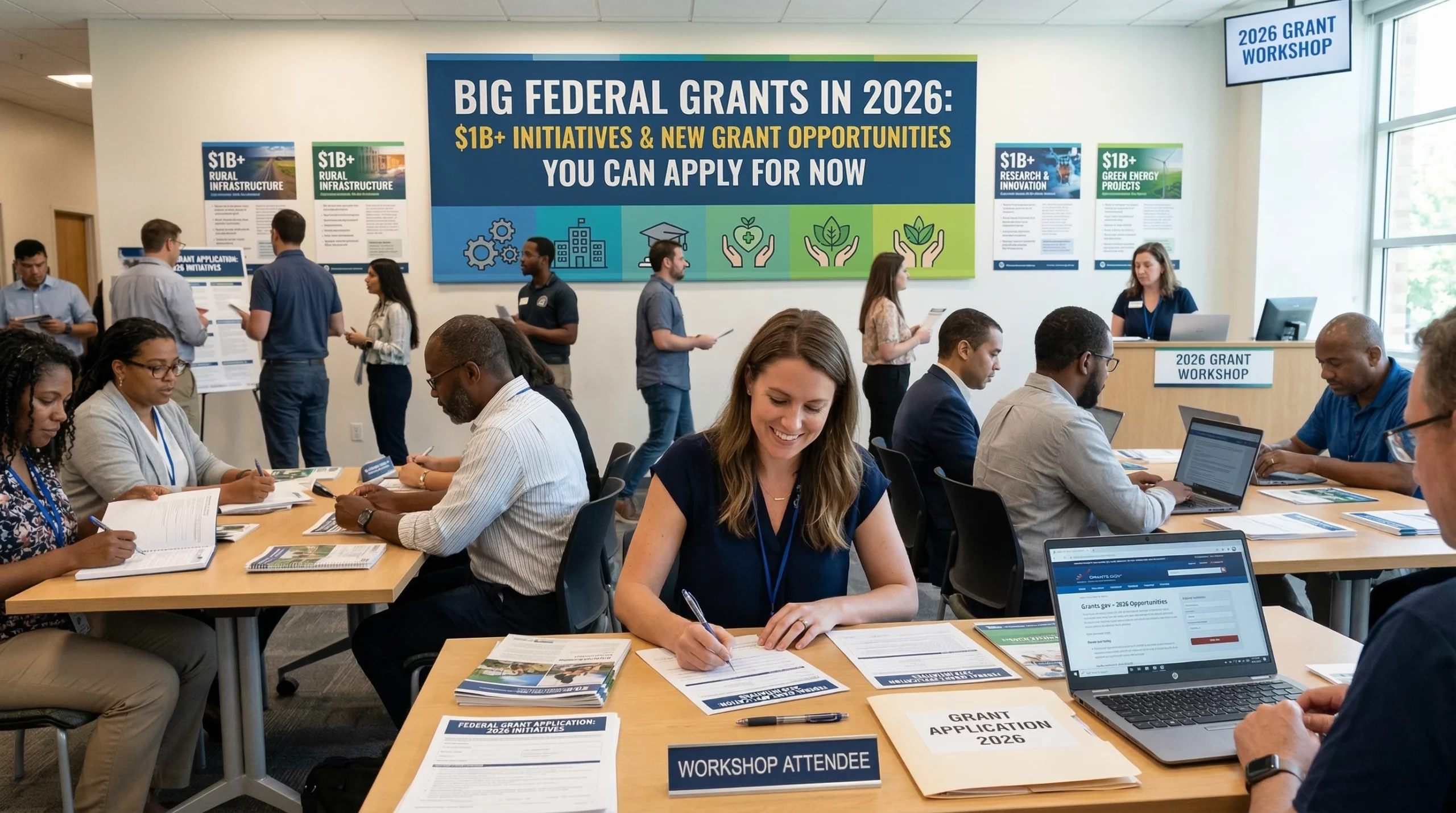
As fiscal year (FY) 2026 funding cycles open across federal agencies, several $1 billion-plus federal grant initiatives are now accepting applications or preparing Notices of Funding Opportunity (NOFOs). These large-scale programs, administered by departments including the U.S. Department of Energy, U.S. Department of Transportation, U.S. Department of Health and Human Services, and U.S. Department of Education, are central to national policy priorities, clean energy deployment, infrastructure modernization, public health resilience, workforce development, and advanced manufacturing.
This guide provides verified 2026–2026 updates, eligibility breakdowns, funding levels, application steps, and official resources. It separates time-sensitive deadlines from evergreen eligibility principles to help applicants act quickly and plan strategically.
$1B+ Federal Grant Programs Active or Announced for FY 2026
Below are major initiatives with cumulative funding exceeding $1 billion nationally.
| Program Name | Agency | FY 2026 Funding Status | Primary Applicants | Focus Area |
| Grid Resilience & Innovation Partnerships (GRIP) | DOE | Continuing rounds (2026–2026) | Utilities, states, tribal govts | Power grid modernization |
| Infrastructure for Rebuilding America (INFRA) | DOT | FY 2026 NOFO expected Q2 2026 | States, MPOs, local govts | Freight & highway infrastructure |
| Broadband Equity, Access, and Deployment (BEAD) | NTIA (Commerce) | State subgrants ongoing | States → local providers | Broadband expansion |
| Title I Grants to Local Educational Agencies | ED | Annual formula (FY 2026) | School districts | Low-income student support |
| Public Health Emergency Preparedness (PHEP) | HHS/CDC | FY 2026 continuation | State health departments | Emergency readiness |
Clean Energy & Grid Modernization: DOE Billion-Dollar Programs
The U.S. Department of Energy continues multi-year disbursements under Grid Resilience and Innovation Partnerships (GRIP).
Funding Overview (FY 2026 Update)
- Total authorized funding: Over $10.5 billion (multi-year allocation)
- FY 2026 expected competitive tranche: $1–2 billion
- Cost-sharing required: Typically 20–50%
Eligible Applicants
- State energy offices
- Investor-owned utilities
- Rural electric cooperatives
- Tribal governments
- Public-private energy partnerships
Purpose
- Modernize transmission systems
- Prevent wildfire-related outages
- Enhance cybersecurity for grid systems
Time-Sensitive: Competitive deadlines typically 60–90 days after NOFO release. Monitor Grants.gov weekly.
Evergreen: Cost-share documentation and environmental review compliance under NEPA are mandatory.
Official resource: energy.gov (Office of Clean Energy Demonstrations & Grid Deployment Office)
Transportation Infrastructure: INFRA & Mega Grants (FY 2026)
The U.S. Department of Transportation is expected to release its FY 2026 Notice of Funding Opportunity for the Infrastructure for Rebuilding America (INFRA) program.
Estimated FY 2026 Funding
- Over $1 billion in discretionary grants
- Large projects: $100M+
- Small projects: $5M–$100M
Eligible Entities
- State DOTs
- Metropolitan Planning Organizations (MPOs)
- Local governments
- Tribal governments
- Public authorities
Selection Criteria
- National/regional economic impact
- Safety improvements
- Climate resilience
- Supply chain efficiency
Time-Sensitive: Application windows historically close within 90 days of NOFO publication.
Official resource: transportation.gov/INFRA
Broadband Expansion: BEAD State-Level Subgrants (2026–2026)
The Broadband Equity, Access, and Deployment (BEAD) Program, administered by the National Telecommunications and Information Administration under the U.S. Department of Commerce, exceeds $42 billion nationally.
FY 2026 Status
All 50 states and territories are in subgrant implementation phases. Funding now flows through state broadband offices.
Who Can Apply?
- Internet Service Providers (ISPs)
- Local governments
- Electric cooperatives
- Public-private broadband partnerships
Funding Focus
- Unserved and underserved communities
- Rural and tribal broadband access
- Affordable connectivity
Hyperlocal Tip: Each state publishes its own BEAD subgrant portal and deadlines. Check your state broadband office website.
Official resource: internetforall.gov
Education Funding: Title I & Competitive Innovation Grants
The U.S. Department of Education continues distributing over $18 billion annually in Title I formula funding.
FY 2026 Updates
- Formula grants automatically allocated to school districts
- Supplemental competitive innovation funds expected in mid-2026
Eligible Beneficiaries
- Local Educational Agencies (LEAs)
- Public school districts
- Charter school networks
Evergreen: Title I eligibility is based on census poverty data and state education formulas.
Official resource: ed.gov
Public Health Preparedness Grants (HHS/CDC)
The U.S. Department of Health and Human Services continues billion-dollar investments in emergency readiness.
FY 2026 Focus Areas
- Disease surveillance modernization
- Laboratory infrastructure
- Workforce capacity expansion
Eligible Entities
- State and territorial health departments
- Major city health agencies
Time-Sensitive: Continuation applications are typically due in late spring.
Official resource: cdc.gov/grants
How to Apply for Big Federal Grants in 2026 (Step-by-Step)
1. Register in Required Federal Systems (Evergreen)
- SAM.gov (active Unique Entity ID required)
- Grants.gov registration
- Agency-specific portals if applicable
2. Review the Notice of Funding Opportunity (NOFO)
Read eligibility definitions carefully. Pay attention to:
- Matching requirements
- Funding ceilings
- Allowable vs. unallowable costs
3. Prepare Required Documents
Typical documentation includes:
- Project narrative (10–50 pages depending on agency)
- SF-424 Application Form
- Budget justification worksheet
- Environmental compliance certification
- Letters of support (if required)
4. Submit Before Deadline (Time-Sensitive)
Late submissions are automatically rejected unless federal systems fail.
Evergreen vs. Time-Sensitive Federal Grant Content: What to Update and What Remains Constant
| Evergreen | Requires Annual Update |
| SAM registration steps | Funding totals |
| Eligibility definitions | Application deadlines |
| Cost-sharing principles | Program rule amendments |
| Federal compliance basics | NOFO release dates |
Editorial Note: Review this article quarterly to update funding levels and deadlines.
Strategic Monitoring Framework for Federal Grant Opportunities (FY 2026)
- Review Grants.gov Weekly: Track newly released Notices of Funding Opportunity (NOFOs), amendments, and deadline extensions.
- Subscribe to Agency Bulletins: Sign up for email alerts from relevant federal departments to receive program updates directly.
- Monitor Federal Register Notices: Watch for regulatory changes, funding announcements, and policy updates affecting eligibility or compliance.
- Track State-Level Subgrant Portals: Many federal funds (e.g., broadband, workforce, infrastructure) flow through state agencies before local distribution.
Navigating the Competitive Federal Grant Environment in 2026
The FY 2026 federal grant cycle signals continued national investment in infrastructure modernization, clean energy resilience, broadband expansion, education equity, and public health preparedness. While appropriations remain substantial, competition has intensified as more states, nonprofits, and private entities pursue large-scale funding.
Successful applicants approach federal grants not as isolated funding events, but as structured, multi-year partnerships requiring sustained compliance, financial oversight, performance reporting, and regulatory alignment. Early preparation, accurate documentation, and strict adherence to federal guidance remain decisive factors in award selection and long-term program sustainability.
FAQs
Who is eligible for billion-dollar federal grants in 2026?
Eligibility varies by program but typically includes state and local governments, tribal entities, school districts, nonprofits, public utilities, and some private companies.
How much funding is available in 2026?
Major programs exceed $1 billion nationally, with awards ranging from $1M–$10M for small grants to $100M+ for large infrastructure projects.
How do I apply for federal grants in 2026?
Register at SAM.gov, monitor Grants.gov for NOFOs, follow agency guidance, and submit your application before the deadline.
What documents are required?
Commonly required documents include the SF-424 form, project narrative, detailed budget, cost-share documentation, and compliance certifications.
What are common reasons federal grant applications are rejected?
Applications are often rejected due to incomplete SAM registration, missing attachments, budget errors, eligibility issues, or late submission.
Sources:


Final Call for LIHEAP 2026: Many States Ending Applications This April

How Startups Can Get SBIR/STTR Funding in 2026

What Single Moms Need to Know About 2026 State Child Tax Credits

Major 2026 SNAP Changes: What CalFresh Recipients Need to Know

25 Small Business Grants You Can Apply for in 2025

Top Veterans Financial Assistance Programs 2025

How to Get Free Help Paying Your Electric Bill

LIHEAP 2025 Application Guide for Energy Assistance
-
 Small Business Grants11 months ago
25 Small Business Grants You Can Apply for in 2025
-
 Veterans Assistance11 months ago
Top Veterans Financial Assistance Programs 2025
-
 Utility & Bills Help11 months ago
How to Get Free Help Paying Your Electric Bill
-
 Utility & Bills Help11 months ago
LIHEAP 2025 Application Guide for Energy Assistance
-

 Food & EBT / SNAP Benefits11 months ago
Fast Food Places That Accept EBT Cards (Full List)
-

 Housing Assistance11 months ago
Apply for Section 8 Housing Vouchers (Updated 2025)
-

 Small Business Grants10 months ago
Women-Owned Business Grants & Funding Sources
-

 Government Grants11 months ago
How to Apply for Government Grants Online
-

 Government Grants11 months ago
25 Federal Grants That Give Free Money in 2025
-

 Disability Benefits11 months ago
How Much Disability Pay Can You Get in 2025?