
Utility & Bills Help
How to Apply for LIHEAP in 2026: Step‑by‑Step Guide by State

The Low Income Home Energy Assistance Program (LIHEAP) is a federally funded block grant administered by the U.S. Department of Health and Human Services (HHS) that helps low‑income households pay home energy costs. Each state and territory operates its own application process within federal guidelines. This step‑by‑step guide explains how to apply for LIHEAP in 2026, including eligibility, timelines, and state‑specific application routes.
What Is LIHEAP?
LIHEAP provides financial assistance to eligible households for heating and cooling energy costs and emergency energy assistance (crisis grants). It operates under the Low Income Home Energy Assistance Act of 1981 and is funded annually through a federal block grant. (ACF)
Who Administers LIHEAP?
- Federal: Office of Community Services (OCS), Administration for Children and Families (ACF), HHS.
- State and Local: State human services agencies, community action agencies, and local service providers determine eligibility and process applications under federal rules. (ACF)
Program Year & Key Dates
LIHEAP seasons vary by state. Below are 2026–26 application windows confirmed from official state sources.
- Indiana: October 1, 2026 – April 20, 2026. (Indian Government)
- Pennsylvania: December 3, 2026 – April 10, 2026. (Pennsylvania Government)
- North Carolina: January 2, 2026 – March 31, 2026 (or until funds are exhausted). (North Carolina DHHS)
- Iowa: October 1/November 1, 2026 – April 30, 2026 (phased start). (Health & Human Services)
Note: Federal guidance for state LIHEAP allotments and plan submissions is based on FY26 model plan requirements. (ACF)
Eligibility Criteria
While states set specific income limits and preferences, basic federal LIHEAP eligibility includes:
- Income Thresholds: Typically at or below certain percentages of the Federal Poverty Level (FPL) or state median income. (Example: PA uses 150% of FPL for eligibility; other states differ.) (Pennsylvania Government)
- Citizenship/Residency: Applicants must reside in the state territory and meet citizenship or eligible non‑citizen criteria.
- Energy Responsibility: The household must be responsible for home energy costs.
- Documentation: Proof of identity, income, utility obligations, and household composition.
Each state may include preferences (e.g., elderly, disabled, families with young children). Always verify locally. (Pennsylvania Government)
How to Apply for LIHEAP in 2026 (Step‑by‑Step)
1. Verify Eligibility
- Compare household income against state‑specific limits (often monthly or annual).
- Confirm energy cost responsibility (heat, electric, cooling).
- Prepare documentation: ID, income verification (pay stubs, benefits notices), utility statements, Social Security numbers, and disconnection notices for crisis assistance.
2. Identify Your State Application Portal
There is no single national LIHEAP application, you must apply through your state’s authorized portal or local service agency. Trustee resources include 211 help lines and state human services websites.
3. Choose Your Application Method
States typically allow one or more of the following:
- Online: Most states (e.g., Pennsylvania via COMPASS). (Pennsylvania Government)
- Mail: Completed applications with verified documents. (DOEE)
- In‑Person: At community action agencies or energy assistance centers. (DOEE)
- Phone: Some states support telephone intake or referral (e.g., call 311 in DC). (DOEE)
4. Submit Required Documents
Common requirements include:
- Government‑issued photo ID
- Proof of income for all household members
- Recent utility bills
- Social Security documentation
- Emergency/crisis documentation (if applicable) (DOEE)
5. Review, Track, and Follow Up
After submission, you should:
- Track application status via your state portal.
- Respond promptly to any request for additional information.
- Confirm acceptance and payment timing with your utility provider.
Common Eligible Benefits Under LIHEAP
| Benefit Type | Description |
| Cash Grant | One‑time payment to assist with seasonal heating/cooling costs. (Pennsylvania Government) |
| Crisis Assistance | Additional aid for imminent loss of energy service. (Pennsylvania Government) |
| Emergency Intervention | Payments based on serious disconnection or fuel depletion. (DOEE) |
FAQs
Who is eligible for LIHEAP in 2026?
Eligibility varies by state but generally requires income at or below state‑specific thresholds, citizenship or eligible non‑citizen status, and responsibility for home energy costs.
How much funding is available?
LIHEAP grants vary by household size, income, and energy type. Pennsylvania, for example, provides $200–$1,000 cash grants.
How do I apply?
Applications are submitted through official state portals, mail, or local service agencies. There is no single national application link.
What documents do I need?
Required: ID, income verification, utility bills, Social Security numbers, and crisis documentation if applicable.
Why was my LIHEAP application delayed?
Processing delays can occur due to federal funding issues or administrative pauses at the state level. Always follow up with your state agency.
State-by-State LIHEAP Application Schedule
| State | Application Season | Apply Online |
| Indiana | Oct 1, 2026 – Apr 20, 2026 | Yes (state portal) (Indian Government) |
| Pennsylvania | Dec 3, 2026 – Apr 10, 2026 | Yes (COMPASS) (Pennsylvania Government) |
| North Carolina | Jan 2 – Mar 31, 2026 | Yes/Contact NCDHHS (North Carolina DHHS) |
| Iowa | Oct/Nov 2026 – Apr 30, 2026 | Yes/State DHS (Health & Human Services) |
Sources:
- U.S. HHS, Office of Community Services (LIHEAP Model Plan FY26) — federal program guidelines. (ACF)
- State agency portals (e.g., PA COMPASS, IN EAP, local DHS) — confirmed application sources. (Indian Government)
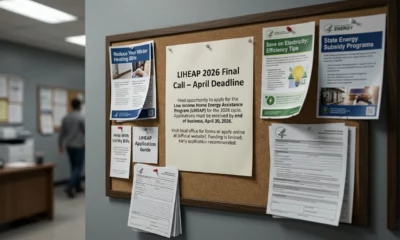


Final Call for LIHEAP 2026: Many States Ending Applications This April

How Startups Can Get SBIR/STTR Funding in 2026

What Single Moms Need to Know About 2026 State Child Tax Credits

Major 2026 SNAP Changes: What CalFresh Recipients Need to Know

25 Small Business Grants You Can Apply for in 2025

Top Veterans Financial Assistance Programs 2025

How to Get Free Help Paying Your Electric Bill

LIHEAP 2025 Application Guide for Energy Assistance
-
 Small Business Grants11 months ago
25 Small Business Grants You Can Apply for in 2025
-
 Veterans Assistance11 months ago
Top Veterans Financial Assistance Programs 2025
-
 Utility & Bills Help11 months ago
How to Get Free Help Paying Your Electric Bill
-
 Utility & Bills Help11 months ago
LIHEAP 2025 Application Guide for Energy Assistance
-

 Food & EBT / SNAP Benefits11 months ago
Fast Food Places That Accept EBT Cards (Full List)
-

 Housing Assistance11 months ago
Apply for Section 8 Housing Vouchers (Updated 2025)
-

 Small Business Grants10 months ago
Women-Owned Business Grants & Funding Sources
-

 Government Grants11 months ago
How to Apply for Government Grants Online
-

 Government Grants11 months ago
25 Federal Grants That Give Free Money in 2025
-

 Disability Benefits11 months ago
How Much Disability Pay Can You Get in 2025?