
Government Grants
Top 2026 Grant Opportunities in the USA: What’s Open Now?
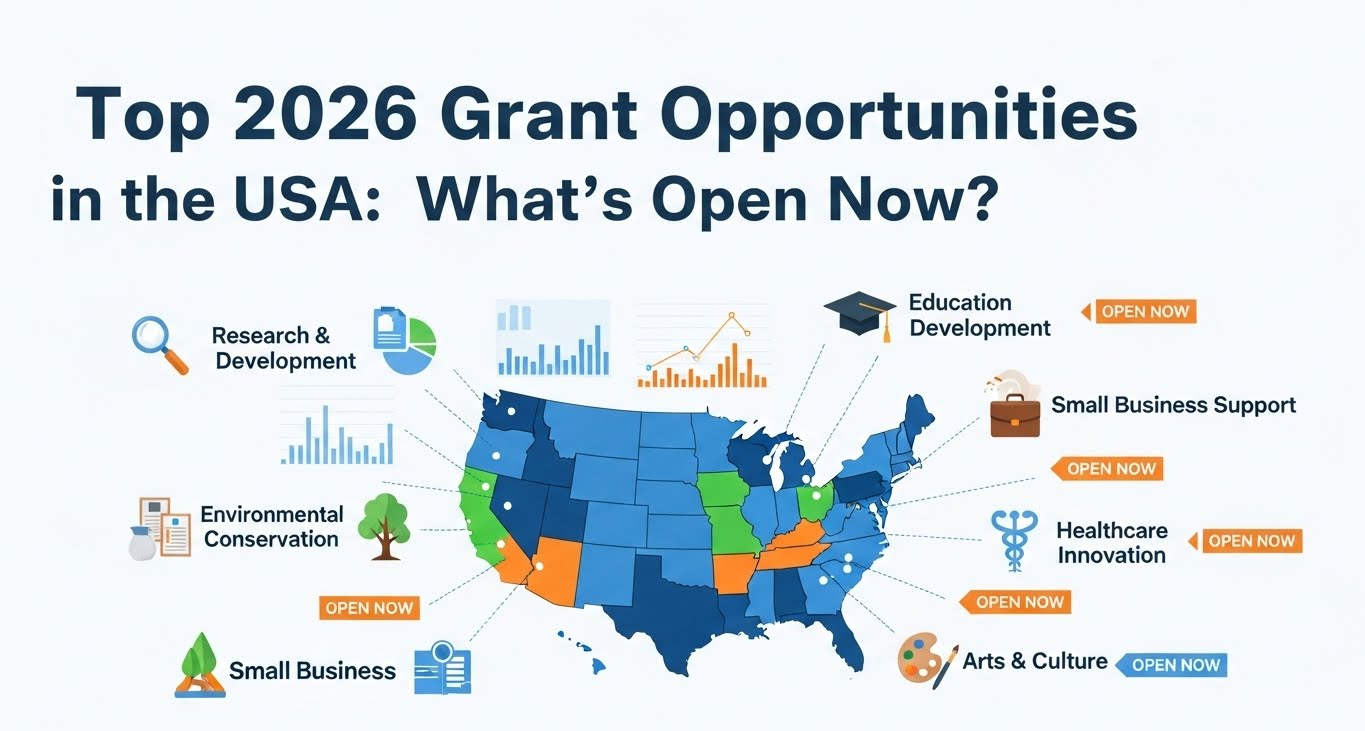
As the federal government transitions toward Fiscal Year (FY) 2026, several major U.S. grant programs are already open, rolling, or preparing their next funding cycles. These grants, administered by federal departments and agencies under permanent statutory authority, support education, research, small businesses, infrastructure, healthcare, housing, and climate resilience.
This guide provides a fact-checked, policy-grounded overview of the top 2026 grant opportunities currently active or expected to open based on official federal funding structures, with a focus on eligibility, funding purpose, and application readiness.
Federal Grant Landscape for FY 2026: Policy Context
Federal grants operate on multi-year authorizations approved by Congress and administered annually by executive agencies. While final FY 2026 appropriations depend on congressional budget action, most core grant programs renew annually unless explicitly sunset by statute.
Programs listed below are:
- Authorized in federal law
- Actively funded in FY 2024–2026
- Expected to continue into FY 2026 under existing policy frameworks
Top 2026 Grant Opportunities Currently Open or Rolling
1. Small Business Innovation Research (SBIR) & STTR Programs
Administering agencies: SBA, NIH, NSF, DoD, DOE, NASA
Purpose
To support early-stage R&D by U.S.-based small businesses developing commercially viable technologies aligned with federal mission needs.
Who Is Eligible
- For-profit U.S. small businesses
- Fewer than 500 employees
- Majority U.S. ownership
Funding Range
| Phase | Typical Amount |
| Phase I | $50,000 – $275,000 |
| Phase II | Up to $1.5 million |
| Phase III | Non-SBIR commercialization |
Why This Grant Exists
Congress mandates SBIR/STTR to bridge the gap between research and commercialization, particularly in defense, healthcare, energy, and advanced manufacturing.
2. National Science Foundation (NSF) Research Grants
Administering agency: National Science Foundation
Purpose
To fund basic and applied research across science, engineering, education, and emerging technologies.
Eligible Applicants
- Universities and colleges
- Nonprofit research institutions
- Small businesses (select programs)
- State and local governments (limited programs)
Funding Scope
- $100,000 to $5+ million depending on program
- Multi-year awards common
Policy Context
NSF funding is authorized under the National Science Foundation Act, with annual appropriations renewed consistently.
Evergreen programs include:
- Core Research Programs
- STEM Education & Workforce Development
- Advanced Technological Education (ATE)
3. NIH Grants (Health & Biomedical Research)
Administering agency: National Institutes of Health (HHS)
Purpose
To advance medical, behavioral, and public health research benefiting national health priorities.
Who Can Apply
Common Grant Mechanisms
- R01 – Investigator-initiated research
- R21 – Exploratory studies
- R03 – Small research projects
Funding Levels
- $50,000 to several million dollars per project
Compliance note: NIH grants require strict adherence to human subjects, data sharing, and reporting regulations.
4. Department of Education Discretionary Grants
Administering agency: U.S. Department of Education
Purpose
To improve educational access, equity, and outcomes, particularly for underserved populations.
Key 2026-Relevant Programs
- TRIO Programs
- GEAR UP
- Teacher Quality Partnerships
- Special Education (IDEA discretionary grants)
Eligible Entities
- Local education agencies
- States
- Colleges and universities
- Nonprofits
Funding Characteristics
- Competitive grants
- Multi-year awards
- Program-specific eligibility rules
5. Community Development Block Grant (CDBG) Program
Administering agency: HUD
Purpose
To support housing, infrastructure, and economic development in low- and moderate-income communities.
Who Benefits
- State and local governments
- Urban counties and entitlement communities
Funding Model
- Formula-based (not competitive)
- Annual allocations
Policy Foundation
Authorized under the Housing and Community Development Act, CDBG is one of the longest-running federal aid programs.
6. Department of Energy (DOE) Clean Energy & Infrastructure Grants
Administering agency: U.S. Department of Energy
Purpose
To accelerate clean energy deployment, grid modernization, and industrial decarbonization.
Eligible Applicants
- State and local governments
- Utilities
- Tribes
- Nonprofits
- Private sector partners (varies by program)
Funding Range
- $250,000 to tens of millions for large infrastructure projects
Why It Matters
DOE grants align with federal climate and energy security mandates and are structured as multi-year funding initiatives.
Common Eligibility & Application Requirements
Most federal grants require:
- UEI registration (Unique Entity Identifier)
- Active SAM.gov status
- Organizational financial documentation
- Program-specific compliance certifications
- Evidence of capacity and prior performance
Frequent reasons for rejection
- Incomplete documentation
- Failure to meet statutory eligibility
- Weak alignment with program objectives
- Noncompliance with formatting or submission rules
Sources:
- Grants.gov – Central Federal Grant Portal
https://www.grants.gov
One-stop portal for finding and applying to all federal grant opportunities. - SAM.gov – Entity Registration & Compliance
https://www.sam.gov
Mandatory registration for organizations to receive federal funding. - Small Business Innovation Research (SBIR/STTR) Portal
https://www.sbir.gov
Official source for federal R&D funding opportunities for U.S. small businesses. - NIH Grants & Funding Portal
https://grants.nih.gov
Central hub for biomedical, behavioral, and public health research grants. - NSF Funding Opportunities Database
https://www.nsf.gov/funding
Comprehensive resource for science, technology, and STEM-related federal grants.





Top States Providing Financial Relief and Emergency Cash Assistance in 2026

Section 811 Housing Assistance 2026: What Disabled Adults Need to Know

Top U.S. Government AI Grants You Should Watch in 2026

VA Closing Cost Assistance for Veterans in 2026: What’s Really Changed This Year?

Fast Food Places That Accept EBT Cards (Full List)

25 Small Business Grants You Can Apply for in 2026

Affordable Housing and Rental Assistance Programs for Texas Single Moms

Most Commonly Approved Government Grant Applications
-
 Food & EBT / SNAP Benefits6 months ago
Fast Food Places That Accept EBT Cards (Full List)
-
 Small Business Grants6 months ago
25 Small Business Grants You Can Apply for in 2026
-
 Single Mothers Benefits4 months ago
Affordable Housing and Rental Assistance Programs for Texas Single Moms
-
 Government Grants6 months ago
Most Commonly Approved Government Grant Applications
-

 Veterans Assistance4 months ago
Top Veterans Financial Assistance Programs 2026
-

 Single Mothers Benefits5 months ago
Trump Tax Plan Stay-at-Home Mom Tax Credit Explained: What the Law Actually Says (2026)
-

 Utility & Bills Help6 months ago
LIHEAP 2026 Application Guide for Energy Assistance
-

 Utility & Bills Help5 months ago
How to Get Free Help Paying Your Electric Bill
-

 Food & EBT / SNAP Benefits5 months ago
5 Key SNAP Policy Changes Coming in 2026 You Should Know
-

 Government Grants6 months ago
How to Apply for Government Grants Online