
Housing Assistance
HUD’s Withdrawal of Fair Housing Guidance: Legal Impacts in 2026
The HUD’s Withdrawal of Fair Housing Guidance: Legal Impacts in 2026 marks a significant regulatory shift affecting applicants, nonprofits, housing providers, and local governments. In late 2026 and early 2026, the U.S. Department of Housing and Urban Development (HUD) rescinded key interpretive guidance related to fair housing enforcement, particularly around disparate impact standards, tenant screening policies, and algorithmic bias in housing decisions.
This move has immediate legal and operational consequences, especially for organizations dependent on federal housing funds, grants, and compliance certifications. This article provides a verified, policy-driven breakdown of what changed, who is affected, and how to stay compliant in 2026.
What HUD Withdrew and Why
HUD’s withdrawn guidance primarily included:
- Interpretations of the Fair Housing Act (FHA)
- Clarifications on discriminatory effects (disparate impact) liability
- Guidance on criminal background checks in tenant screening
- Early frameworks addressing AI and algorithmic discrimination in housing
Policy Context
- The Fair Housing Act prohibits discrimination based on race, color, religion, sex, disability, familial status, or national origin.
- Prior HUD guidance (2013–2021) expanded enforcement by clarifying how seemingly neutral policies could still be discriminatory.
- The 2026–2026 withdrawal reflects a shift toward narrower statutory interpretation and reduced reliance on informal guidance.
Key Insight:
The withdrawal does not repeal the law, but it removes interpretive frameworks that many stakeholders relied on for compliance.
Legal Impacts in 2026
1. Increased Compliance Uncertainty
Without HUD’s interpretive guidance:
- Housing providers must rely directly on statutory language and court precedents.
- Ambiguities increase legal risk, especially in:
- Tenant screening
- Zoning decisions
- Lending practices
2. Shift Toward Case-by-Case Enforcement
HUD and courts may now:
- Evaluate discrimination claims without prior guidance benchmarks
- Place greater emphasis on judicial interpretation rather than agency clarification
3. Higher Litigation Risk for Organizations
Organizations, especially NGOs and startups, face:
- Increased exposure to lawsuits due to a lack of safe-harbor guidelines
- Difficulty proving compliance in the absence of standardized rules
4. Impact on Federal Funding and Grants
Entities applying for HUD-related funding must still certify compliance with:
- Fair Housing Act
- Civil Rights Act provisions
However:
- Documentation requirements may become stricter
- Audits may rely more on outcomes than policy alignment
Who Is Affected?
Primary Stakeholders
- Nonprofits and NGOs working in housing or urban development
- Startups using AI in tenant screening or property management
- Local governments managing zoning and housing programs
- Small businesses (landlords, developers, lenders)
- Students and researchers in housing policy
Secondary Impact Groups
- Housing applicants (tenants, buyers)
- Community advocacy groups
- Legal aid organizations
Eligibility & Compliance Requirements
Even after the withdrawal, core eligibility principles remain unchanged:
| Requirement | Details |
| Non-discrimination | Must comply with FHA protected classes |
| Documentation | Maintain records of policies and decisions |
| Transparency | Provide clear criteria for tenant selection |
| Accessibility | Ensure reasonable accommodations for disabilities |
| Federal compliance | Required for HUD grants and funding |
Key Changes in Compliance Practices
Before Withdrawal (Pre-2026)
- Clear HUD guidance on:
- Criminal background checks
- Disparate impact thresholds
- AI bias mitigation
After Withdrawal (2026)
- Organizations must:
- Conduct independent legal reviews
- Use risk-based compliance frameworks
- Monitor court rulings instead of HUD advisories
Funding & Grant Implications
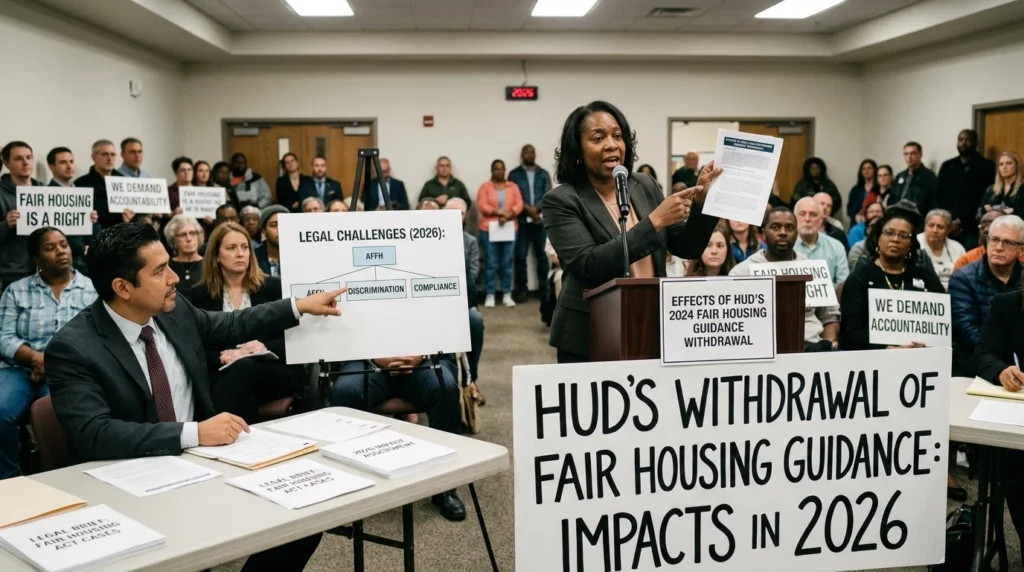
Time-Sensitive (FY 2026 Updates Required)
While HUD has not reduced funding allocations, compliance scrutiny has increased for:
- Community Development Block Grants (CDBG)
- HOME Investment Partnerships Program
- Fair Housing Initiatives Program (FHIP)
What Applicants Must Do
- Update compliance documentation
- Include legal justification for policies
- Demonstrate non-discriminatory outcomes
Application Process
Step-by-Step Guide
- Identify Applicable HUD Program
- Review Updated Compliance Requirements (2026)
- Prepare Documentation
- Policies
- Decision logs
- Impact assessments
- Submit Application via Grants.gov or HUD Portal
- Respond to Compliance Audits
Required Documents
- Organizational registration (EIN, DUNS/UEI)
- Fair Housing compliance certification
- Policy manuals (tenant screening, lending)
- Data reports showing non-discrimination
- Financial statements
Common Reasons for Rejection
- Lack of a documented compliance framework
- Discriminatory outcomes (even if unintended)
- Incomplete or outdated policy documentation
- Failure to align with federal civil rights laws
Practical Guidance for Stakeholders
For NGOs
- Conduct annual compliance audits
- Train staff on legal updates
For Startups
- Review AI algorithms for bias
- Maintain explainability in decision-making
For Local Governments
- Align zoning policies with the FHA
- Document decision-making processes
Frequently Asked Questions (FAQs)
Who is eligible under HUD programs after the 2026 guidance withdrawal?
All entities previously eligible, nonprofits, local governments, and businesses, remain eligible. However, they must independently ensure compliance with the Fair Housing Act without relying on withdrawn HUD guidance.
How much funding is available in 2026?
Funding levels vary by program (e.g., CDBG, HOME). HUD has not reduced allocations, but compliance requirements have tightened. Applicants should check fiscal year 2026 notices for exact figures.
How do I apply for HUD grants in 2026?
Applications must be submitted through Grants.gov or HUD’s official portals. Applicants must include updated compliance documentation reflecting current legal standards.
What documents are required?
Key documents include:
- Fair Housing compliance certification
- Policy documentation
- Data demonstrating non-discrimination
- Financial and organizational records
What are the common reasons for rejection?
Applications are often rejected due to:
- Lack of proper compliance documentation
- Evidence of discriminatory outcomes
- Failure to meet federal civil rights standards
Does the withdrawal change the Fair Housing Act itself?
No. The law remains unchanged. Only HUD’s interpretive guidance has been withdrawn, increasing reliance on courts and statutory interpretation.
Sources:
- HUD Official Website: https://www.hud.gov
- Grants Portal: https://www.grants.gov
- Fair Housing Act Overview: https://www.hud.gov/program_offices/fair_housing_equal_opp

Top States Providing Financial Relief and Emergency Cash Assistance in 2026

Section 811 Housing Assistance 2026: What Disabled Adults Need to Know

Top U.S. Government AI Grants You Should Watch in 2026

VA Closing Cost Assistance for Veterans in 2026: What’s Really Changed This Year?

Fast Food Places That Accept EBT Cards (Full List)

25 Small Business Grants You Can Apply for in 2026

Affordable Housing and Rental Assistance Programs for Texas Single Moms

Most Commonly Approved Government Grant Applications
-
 Food & EBT / SNAP Benefits5 months ago
Fast Food Places That Accept EBT Cards (Full List)
-
 Small Business Grants5 months ago
25 Small Business Grants You Can Apply for in 2026
-
 Single Mothers Benefits3 months ago
Affordable Housing and Rental Assistance Programs for Texas Single Moms
-
 Government Grants5 months ago
Most Commonly Approved Government Grant Applications
-

 Veterans Assistance3 months ago
Top Veterans Financial Assistance Programs 2026
-

 Utility & Bills Help5 months ago
LIHEAP 2026 Application Guide for Energy Assistance
-

 Utility & Bills Help4 months ago
How to Get Free Help Paying Your Electric Bill
-

 Single Mothers Benefits4 months ago
Trump Tax Plan Stay-at-Home Mom Tax Credit Explained: What the Law Actually Says (2026)
-

 Food & EBT / SNAP Benefits3 months ago
5 Key SNAP Policy Changes Coming in 2026 You Should Know
-

 Government Grants5 months ago
How to Apply for Government Grants Online