
Emergency Cash Assistance
$1,000 Monthly Checks in April 2026: Who Is Really Getting Paid?
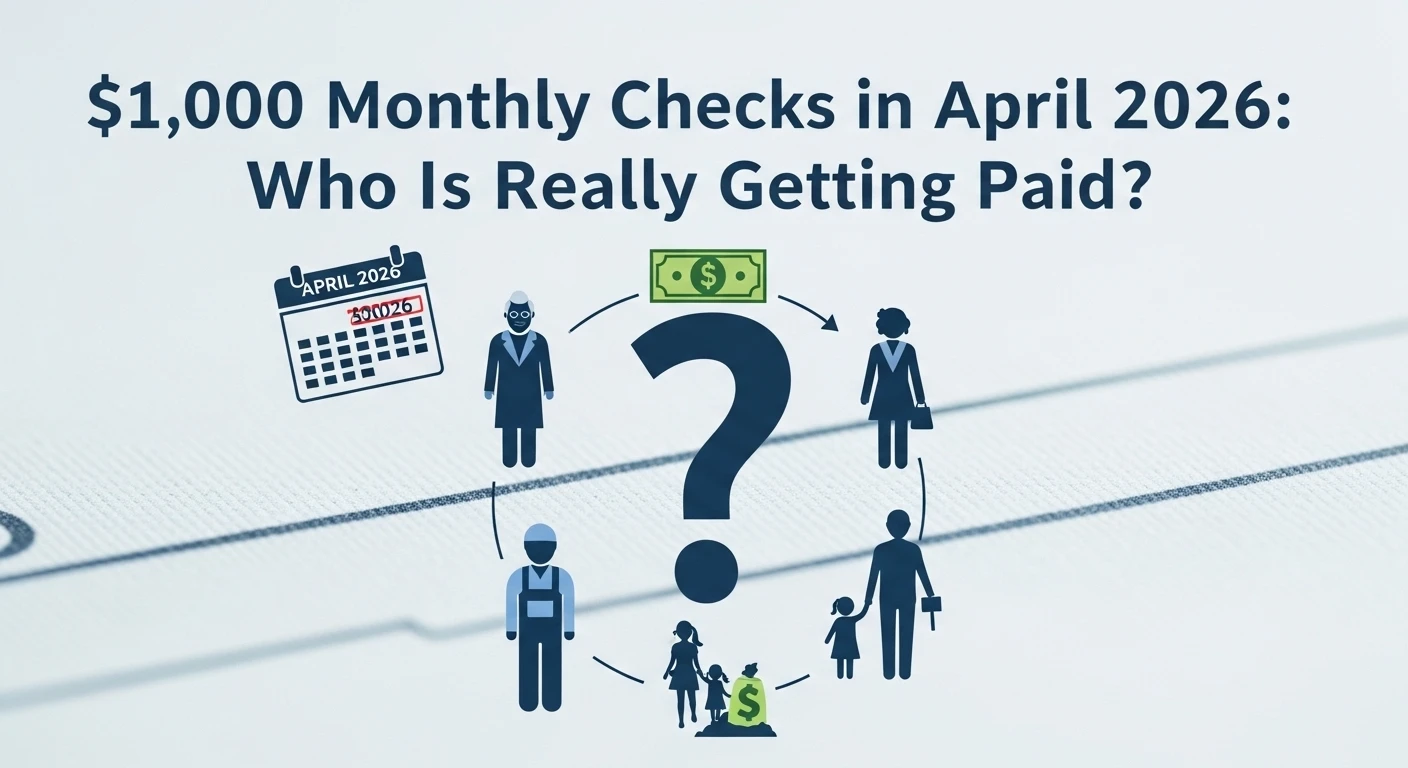
As of April 2026, widespread online claims about “$1,000 monthly checks” have generated significant public interest. However, no universal federal program in the United States currently provides blanket $1,000 monthly payments to all citizens. Instead, targeted government programs, pilot initiatives, and state-level benefits are issuing recurring payments to specific eligible groups.
This guide provides a fact-checked, policy-based breakdown of who is actually receiving these payments, under which programs, and how eligibility works.
What Are the $1,000 Monthly Checks in 2026?
The phrase “$1,000 monthly checks” refers to a combination of programs, not a single federal initiative. These include:
- Guaranteed Income Pilots (GIP)
- State-level relief payments
- Federal benefits with similar payout ranges
- Local government or nonprofit-funded programs
These payments are typically:
- Means-tested (income-based eligibility)
- Geographically limited
- Time-bound (pilot or temporary funding)
Who Is Actually Receiving $1,000 Payments?
1. Guaranteed Income Pilot Participants
Several U.S. cities and counties continue to run Guaranteed Income Programs (GIPs) in 2026–2026.
Examples include:
- Los Angeles Guaranteed Income Program
- Cook County Promise Program (Illinois)
- Harris County Uplift Program (Texas)
Typical eligibility:
- Low-income households (below 200% of poverty line)
- Single parents or caregivers
- Residents of specific zip codes
Payment structure:
- $500–$1,000 per month
- Duration: 6 to 24 months
Time-sensitive: Most of these programs have closed enrollment cycles and limited slots.
2. State-Level Relief and Surplus Rebates
Some states have issued recurring or staggered payments funded by budget surpluses.
States involved (2026–2026 trends):
- California (inflation relief payments)
- New Mexico (rebate programs)
- Alaska (Permanent Fund Dividend variations)
Key facts:
- Payments may reach or approximate $1,000 when combined
- Not always monthly; sometimes quarterly or annual
3. Federal Programs with Similar Payment Levels
While not labeled as “$1,000 checks,” certain federal benefits may reach or exceed this amount monthly:
Social Security (Retirement & Disability)
- Average monthly benefit (2026): $1,800+
- Eligibility: Age, disability, or survivor status
Supplemental Security Income (SSI)
- Federal base rate (2026 estimate): ~$943 (individual)
- With state supplements, can approach $1,000+
Veterans Affairs (VA Benefits)
- Disability compensation varies
- Some recipients receive $1,000+ monthly
4. Nonprofit and Privately Funded Income Programs
Organizations such as:
- Economic Security Project
- Mayors for a Guaranteed Income
Support pilot programs across U.S. municipalities.
These programs:
- Partner with local governments
- Provide no-strings-attached cash assistance
- Focus on economic mobility and poverty reduction
Eligibility Criteria
| Criteria | Details |
| Income Level | Typically below 150%–200% of federal poverty line |
| Residency | Must live in participating city/state |
| Employment Status | Often includes unemployed or underemployed individuals |
| Household Type | Priority for families with children or single parents |
| Documentation | Proof of income, residency, ID |
How to Apply for $1,000 Monthly Programs
Step-by-step process:
- Identify active programs
- Check local government websites
- Monitor county or city announcements
- Verify eligibility
- Review income thresholds
- Confirm residency requirements
- Prepare documents
- Government-issued ID
- Proof of address
- Income statements or tax returns
- Submit application
- Online portals (most common)
- Some require in-person verification
- Lottery selection (if applicable)
- Many programs use random selection due to high demand
Required Documents
- Valid photo ID (driver’s license, passport)
- Utility bills or lease agreement
- Tax returns (2024–2026 filings)
- Pay stubs or unemployment records
- Social Security Number (SSN) or ITIN
Common Reasons for Rejection
- Income exceeds program limits
- Residency outside eligible zones
- Incomplete or incorrect documentation
- Duplicate or fraudulent applications
- Missed application deadlines
Policy Context: Why These Payments Exist
These programs are rooted in broader policy goals:
- Economic recovery post-pandemic
- Inflation relief (2024–2026 cycle)
- Testing Universal Basic Income (UBI) models
- Reducing income inequality
Government agencies and research institutions are evaluating:
- Employment outcomes
- Spending patterns
- Health and education impacts
Latest Updates
- Most large-scale Guaranteed Income pilots are not accepting new applicants as of Q2 2026
- Several programs are transitioning into research evaluation phases
- New pilot announcements are expected in mid-to-late 2026, depending on federal and state budgets
Time-sensitive: Always verify application windows via official city or state portals.
Frequently Asked Questions
Who is eligible for $1,000 monthly checks in April 2026?
Eligibility is limited to low-income individuals or families enrolled in specific local guaranteed income programs, state relief initiatives, or qualifying federal benefits.
Are these payments available nationwide?
No. These payments are not universal. They are limited to specific cities or counties, selected participants, and certain federal benefit recipients.
How much funding is available?
Funding varies by program:
- Guaranteed income pilots: $500–$1,000/month
- Federal benefits: Can exceed $1,000/month depending on eligibility
- State rebates: One-time or periodic payments
How can I apply for these payments?
You must locate an active program in your area, meet eligibility criteria, and submit an application via official government portals.
What documents are required?
Typical documents include proof of identity, residency verification, income records, and tax filings.
Why was my application rejected?
Common reasons include income above threshold, missing documents, ineligible location, or late submission.
Final Takeaway
Despite widespread online narratives, there is no single nationwide $1,000 monthly check program in April 2026. Payments of this size are being distributed through a patchwork of targeted programs, each with strict eligibility rules and limited availability.
For applicants, the key is to focus on local opportunities, monitor official government announcements, and apply early when programs open.
Sources:




Top States Providing Financial Relief and Emergency Cash Assistance in 2026

Section 811 Housing Assistance 2026: What Disabled Adults Need to Know

Top U.S. Government AI Grants You Should Watch in 2026

VA Closing Cost Assistance for Veterans in 2026: What’s Really Changed This Year?

Fast Food Places That Accept EBT Cards (Full List)

25 Small Business Grants You Can Apply for in 2026

Affordable Housing and Rental Assistance Programs for Texas Single Moms

Most Commonly Approved Government Grant Applications
-
 Food & EBT / SNAP Benefits5 months ago
Fast Food Places That Accept EBT Cards (Full List)
-
 Small Business Grants5 months ago
25 Small Business Grants You Can Apply for in 2026
-
 Single Mothers Benefits3 months ago
Affordable Housing and Rental Assistance Programs for Texas Single Moms
-
 Government Grants5 months ago
Most Commonly Approved Government Grant Applications
-

 Veterans Assistance3 months ago
Top Veterans Financial Assistance Programs 2026
-

 Utility & Bills Help5 months ago
LIHEAP 2026 Application Guide for Energy Assistance
-

 Utility & Bills Help4 months ago
How to Get Free Help Paying Your Electric Bill
-

 Single Mothers Benefits4 months ago
Trump Tax Plan Stay-at-Home Mom Tax Credit Explained: What the Law Actually Says (2026)
-

 Food & EBT / SNAP Benefits3 months ago
5 Key SNAP Policy Changes Coming in 2026 You Should Know
-

 Government Grants5 months ago
How to Apply for Government Grants Online