
Emergency Cash Assistance
TANF Michigan 2026: What It Is & How the Family Independence Program (FIP) Works

The Temporary Assistance for Needy Families (TANF) program in Michigan continues to serve as a critical safety net in 2026, providing financial and supportive services to low-income families. Administered by the Michigan Department of Health and Human Services, TANF operates primarily through the Family Independence Program (FIP).
For applicants, NGOs, and public service stakeholders, understanding how FIP works, its eligibility rules, benefit structure, and compliance requirements is essential for accessing or facilitating assistance. This guide reflects verified program structures and policy updates through 2026–2026, with a clear separation between evergreen eligibility rules and time-sensitive funding details.
What Is TANF and the Family Independence Program (FIP)?
TANF is a federally funded, state-administered program created under the Personal Responsibility and Work Opportunity Reconciliation Act. It provides temporary financial assistance while promoting work and self-sufficiency.
In Michigan, TANF is delivered through FIP, which offers monthly cash assistance, employment and training support, child care assistance referrals, and case management through PATH (Partnership. Accountability. Training. Hope.)
Key policy objectives include reducing dependency on public assistance, promoting job readiness and employment, and supporting child well-being in low-income households.
Who Is Eligible for TANF Michigan (FIP)?
Core Eligibility Criteria
To qualify for FIP in 2026, applicants must meet the following:
| Criteria | Requirement |
| Residency | Must live in Michigan |
| Income Limits | Must fall below state-defined thresholds |
| Family Structure | Must have dependent children or be pregnant |
| Citizenship | U.S. citizen or qualified non-citizen |
| Work Participation | Must engage in approved work activities |
| Asset Limits | Limited countable assets (varies annually) |
Additional requirements include cooperation with child support enforcement (if applicable), participation in PATH program activities, and compliance with school attendance for minor children.
Eligibility principles remain consistent each year, but income thresholds and asset limits may be adjusted annually.
How Much Financial Assistance Is Available?
Benefit Amounts
FIP payments vary based on household size and income:
| Household Size | Maximum Monthly Benefit (Approx.) |
| 1 adult + 1 child | $400–$500 |
| 1 adult + 2 children | $500–$650 |
| 1 adult + 3 children | $650–$800 |
These figures are estimates based on recent MDHHS schedules (2026–2026) and may change with state budget adjustments, federal TANF block grant allocations, and cost-of-living revisions.
Additional support services may include child care subsidies, transportation assistance, and job training programs.
How the PATH Program Works
All FIP recipients must participate in the PATH program, Michigan’s employment initiative.
Key components include skills assessment, job readiness training, resume and interview preparation, and direct job placement assistance.
Failure to comply with PATH requirements may result in benefit reduction, temporary suspension, or case closure in repeated non-compliance cases.
How to Apply for TANF Michigan (FIP)
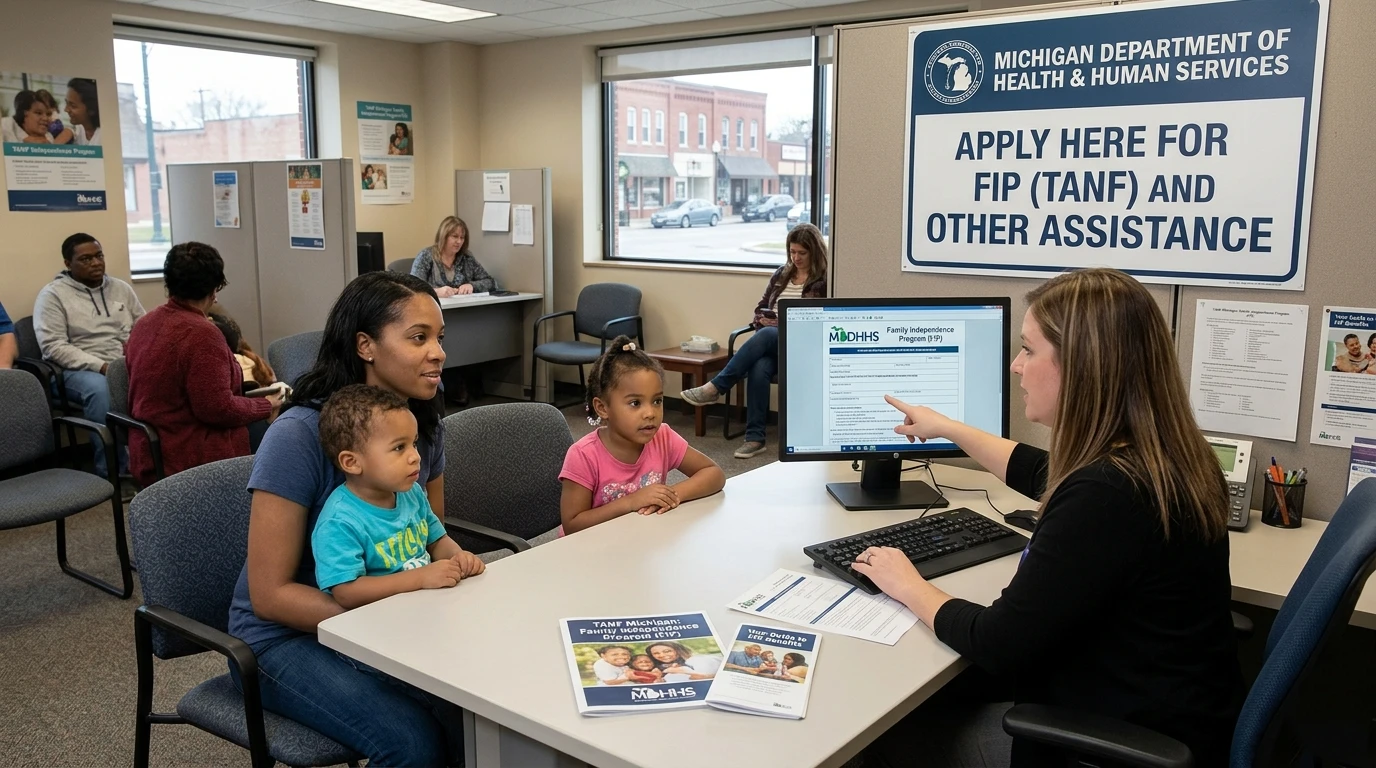
Step-by-Step Application Process
- Apply online via the MI Bridges portal
- Submit required documents, including identity verification, proof of income, residency documentation, and Social Security numbers
- Complete an interview with an MDHHS caseworker
- Await eligibility determination, typically within 30–45 days
- Enroll in the PATH program for ongoing benefits
Required Documents Checklist
Applicants should prepare a government-issued ID, birth certificates for children, pay stubs or income records, rent or utility bills, bank statements, and immigration documentation if applicable.
Incomplete documentation is a leading cause of delays.
Common Reasons for Application Rejection
Common denial factors include income exceeding eligibility limits, missing or incomplete documentation, failure to comply with PATH requirements, failure to attend scheduled interviews, and lack of cooperation with child support enforcement.
These criteria are consistent across most TANF programs nationally, though enforcement varies by state.
Policy Updates and 2026 Considerations
As of 2026–2026, there is increased focus on workforce participation metrics, digital application improvements via MI Bridges, continued federal TANF block grant funding stability, and pilot programs for workforce re-entry and skills training.
Stakeholders should monitor annual state budget releases, MDHHS policy bulletins, and federal TANF reauthorization discussions.
Frequently Asked Questions
Who is eligible for TANF in Michigan?
Eligibility requires Michigan residency, low income, dependent children or pregnancy, and participation in work-related activities under the PATH program.
How much money can I receive from FIP?
Monthly benefits typically range from $400 to $800, depending on household size and income. Final amounts are determined by MDHHS guidelines for the fiscal year.
How do I apply for TANF Michigan?
Applications are submitted online through the MI Bridges portal, followed by document submission and an eligibility interview with MDHHS.
What documents are required for FIP?
You need identification, proof of income, residency documents, Social Security numbers, and household financial records.
Why was my TANF application denied?
Common reasons include exceeding income limits, missing documents, failure to attend interviews, or non-compliance with PATH program requirements.
Sources

Top States Providing Financial Relief and Emergency Cash Assistance in 2026

Section 811 Housing Assistance 2026: What Disabled Adults Need to Know

Top U.S. Government AI Grants You Should Watch in 2026

VA Closing Cost Assistance for Veterans in 2026: What’s Really Changed This Year?

Fast Food Places That Accept EBT Cards (Full List)

25 Small Business Grants You Can Apply for in 2026

Affordable Housing and Rental Assistance Programs for Texas Single Moms

Most Commonly Approved Government Grant Applications
-
 Food & EBT / SNAP Benefits5 months ago
Fast Food Places That Accept EBT Cards (Full List)
-
 Small Business Grants5 months ago
25 Small Business Grants You Can Apply for in 2026
-
 Single Mothers Benefits3 months ago
Affordable Housing and Rental Assistance Programs for Texas Single Moms
-
 Government Grants5 months ago
Most Commonly Approved Government Grant Applications
-

 Veterans Assistance3 months ago
Top Veterans Financial Assistance Programs 2026
-

 Utility & Bills Help5 months ago
LIHEAP 2026 Application Guide for Energy Assistance
-

 Utility & Bills Help4 months ago
How to Get Free Help Paying Your Electric Bill
-

 Single Mothers Benefits4 months ago
Trump Tax Plan Stay-at-Home Mom Tax Credit Explained: What the Law Actually Says (2026)
-

 Food & EBT / SNAP Benefits4 months ago
5 Key SNAP Policy Changes Coming in 2026 You Should Know
-

 Government Grants5 months ago
How to Apply for Government Grants Online