
Emergency Cash Assistance
TANF Michigan 2026: What It Is & How the Family Independence Program (FIP) Works
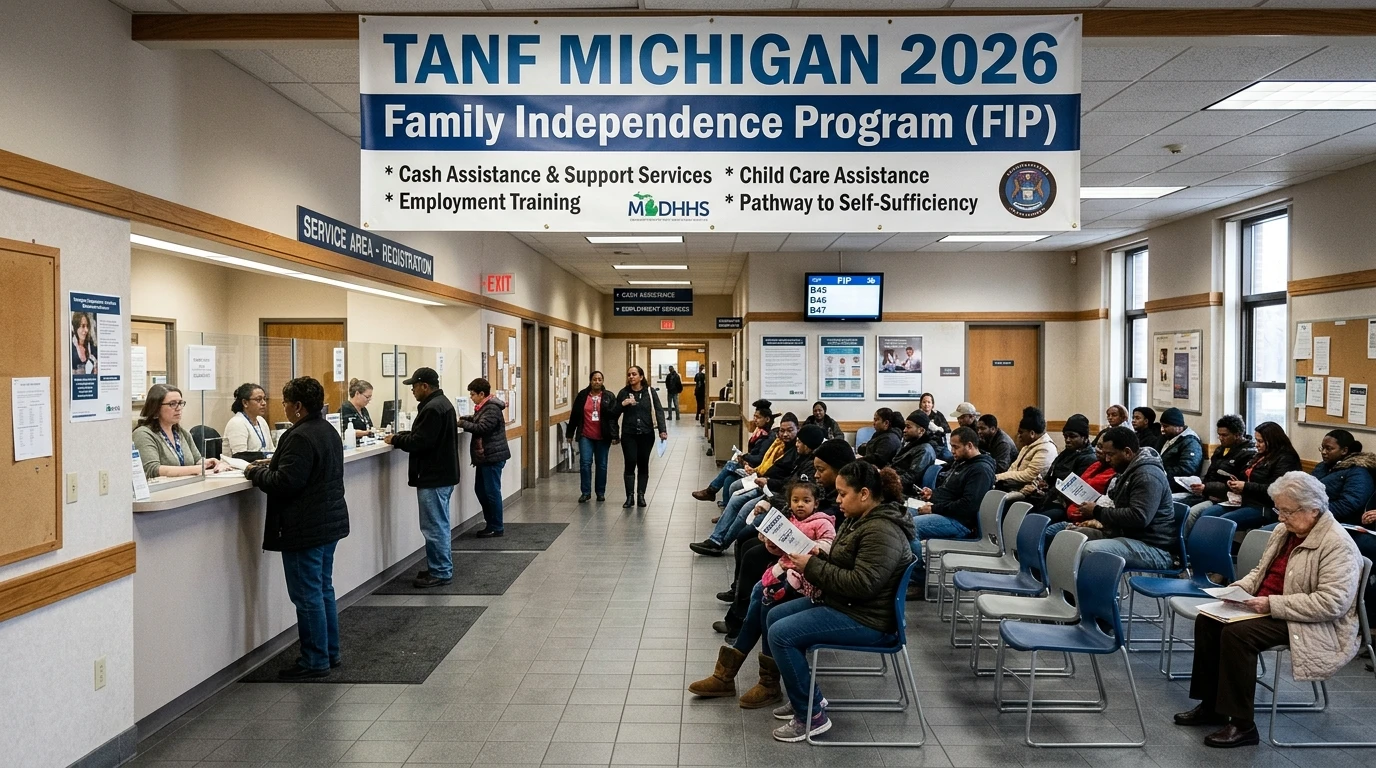
The Temporary Assistance for Needy Families (TANF) program in Michigan remains a critical safety net in 2026, providing financial and employment support to low-income families. Administered by the Michigan Department of Health and Human Services (MDHHS), TANF is primarily delivered through the Family Independence Program (FIP).
For applicants, NGOs, and policy stakeholders, understanding how FIP operates in 2026 is essential, especially as states continue adjusting eligibility thresholds, work requirements, and compliance standards under federal TANF block grant rules.
What Is TANF and How Does It Work in Michigan?
The Temporary Assistance for Needy Families (TANF) program is a federally funded initiative overseen by the U.S. Department of Health and Human Services. It provides block grants to states, allowing them flexibility in designing welfare programs.
In Michigan, TANF is implemented through:
- Family Independence Program (FIP) – Direct cash assistance
- Work First Program – Employment and training services
- Supportive services – Childcare, transportation, and case management
Policy Objective
TANF Michigan 2026 focuses on:
- Reducing dependency on public assistance
- Promoting job readiness and employment
- Supporting child well-being in low-income households
What Is the Family Independence Program (FIP)?
The Family Independence Program (FIP) is Michigan’s core TANF cash assistance program. It provides monthly financial support to eligible families with dependent children.
Key Features of FIP (2026)
- Monthly cash benefits via Electronic Benefit Transfer (EBT)
- Mandatory participation in work-related activities (Work First)
- Time-limited assistance (generally 48 months lifetime cap)
- Caseworker oversight and compliance monitoring
Eligibility Criteria for TANF Michigan 2026
Eligibility is determined by MDHHS based on federal TANF guidelines and state-specific rules.
Basic Eligibility Requirements
| Criteria | Requirement |
| Residency | Must be a resident of Michigan |
| Citizenship | U.S. citizen or qualified non-citizen |
| Income Limits | Must fall below state-defined thresholds |
| Family Structure | Must have dependent children or be pregnant |
| Work Participation | Must comply with Work First requirements |
Income Limits (2026 – Estimated Range)
- Family of 3: Approx. $500–$700/month gross income threshold
- Asset limits: Typically under $15,000 (excluding primary residence
How Much Financial Assistance Is Available?
FIP benefit amounts vary depending on household size and income.
Monthly Benefit Estimates (2026)
| Household Size | Estimated Monthly Benefit |
| 1 adult + 1 child | $300 – $400 |
| 1 adult + 2 children | $400 – $500 |
| Larger families | Scaled accordingly |
Note: These figures are approximate and may change based on:
- State budget allocations
- Federal TANF funding adjustments
- Cost-of-living updates
How to Apply for TANF Michigan (FIP)
Applicants can apply through multiple official channels.
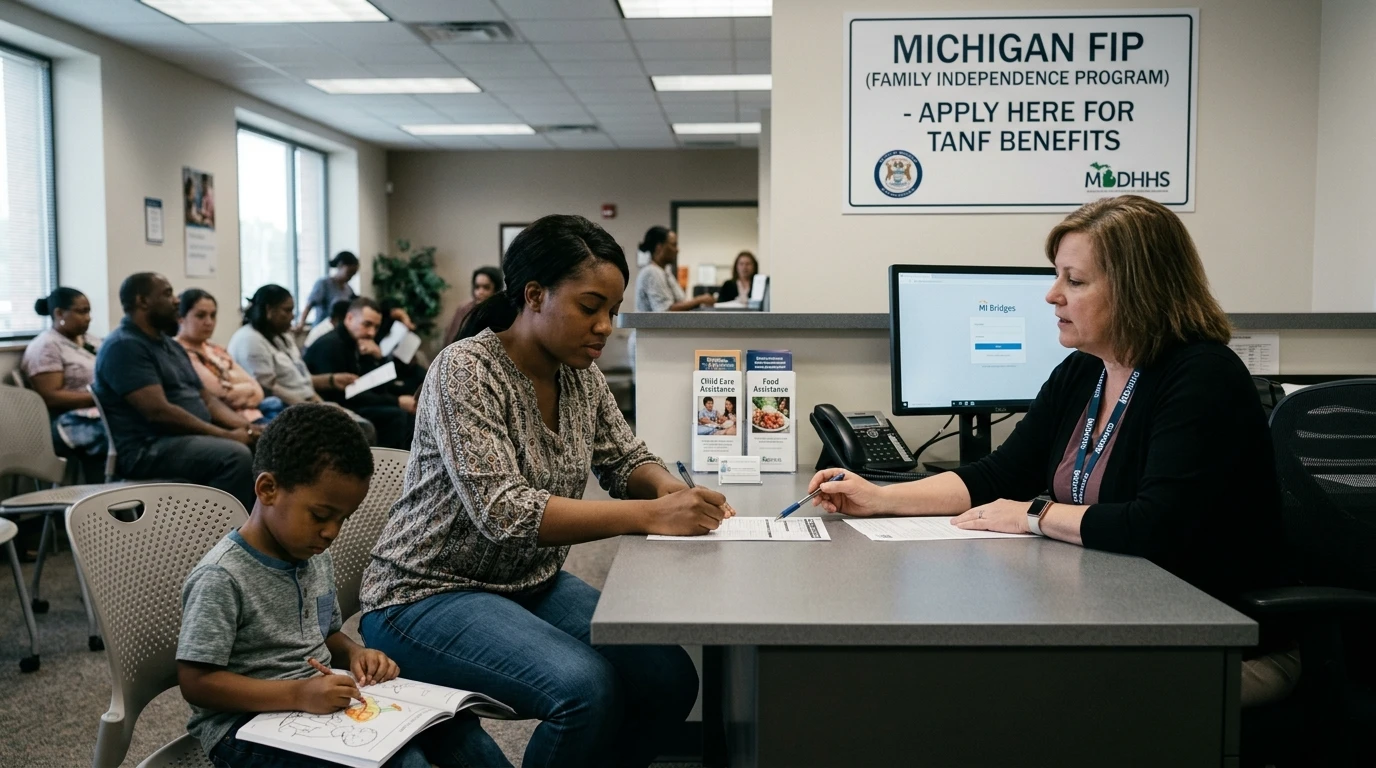
Step-by-Step Application Process
- Online Application
Apply via the MI Bridges portal - Submit Required Documents
Upload or provide verification documents (see below) - Interview with Caseworker
Conducted by MDHHS (phone or in-person) - Eligibility Determination
Decision is typically issued within 30 days - Receive Benefits
Approved applicants receive an EBT card for monthly payments
Required Documents for FIP Application
Applicants must provide verifiable documentation.
Common Requirements
- Proof of identity (driver’s license, state ID)
- Social Security numbers for all household members
- Proof of income (pay stubs, employer letter)
- Proof of residency (utility bill, lease agreement)
- Child dependency verification (birth certificates, school records)
Work Requirements: Michigan Work First Program
Participation in employment-related activities is mandatory for most recipients.
Work First Program Includes:
- Job search assistance
- Skills training and workshops
- Resume development
- Employment placement services
Compliance Rules
Failure to meet work requirements may result in:
- Benefit reduction
- Temporary suspension
- Case closure
Common Reasons for Application Rejection
Understanding denial factors can improve approval chances.
Frequent Issues
- Incomplete documentation
- Income exceeding eligibility limits
- Failure to attend the interview
- Non-compliance with work requirements
- Providing inaccurate or unverifiable information
Time Limits and Program Duration
Lifetime Limits (Evergreen Policy)
- Maximum 48 months of TANF benefits over a lifetime
- Some hardship exemptions may apply
Recertification
- Required periodically (typically every 6–12 months)
- Applicants must update their income and household status
FAQs
Who is eligible for TANF Michigan 2026?
Low-income Michigan residents with dependent children who meet income, residency, and work participation requirements are eligible.
How much money can I receive from FIP?
Benefits typically range from $300 to $500 per month, depending on household size and income, subject to annual adjustments.
How do I apply for TANF in Michigan?
You can apply online through the MI Bridges portal, submit required documents, complete an interview, and await eligibility determination.
What documents are required for the application?
Applicants need proof of identity, income, residency, Social Security numbers, and documentation for dependent children.
What happens if my application is denied?
You can request a hearing or reapply after correcting issues such as missing documents or eligibility discrepancies.
Is there a time limit for receiving TANF benefits?
Yes, Michigan enforces a 48-month lifetime limit, with limited exceptions for hardship cases.
Sources




Top States Providing Financial Relief and Emergency Cash Assistance in 2026

Section 811 Housing Assistance 2026: What Disabled Adults Need to Know

Top U.S. Government AI Grants You Should Watch in 2026

VA Closing Cost Assistance for Veterans in 2026: What’s Really Changed This Year?

Fast Food Places That Accept EBT Cards (Full List)

25 Small Business Grants You Can Apply for in 2026

Affordable Housing and Rental Assistance Programs for Texas Single Moms

Most Commonly Approved Government Grant Applications
-
 Food & EBT / SNAP Benefits5 months ago
Fast Food Places That Accept EBT Cards (Full List)
-
 Small Business Grants5 months ago
25 Small Business Grants You Can Apply for in 2026
-
 Single Mothers Benefits3 months ago
Affordable Housing and Rental Assistance Programs for Texas Single Moms
-
 Government Grants5 months ago
Most Commonly Approved Government Grant Applications
-

 Veterans Assistance3 months ago
Top Veterans Financial Assistance Programs 2026
-

 Utility & Bills Help5 months ago
LIHEAP 2026 Application Guide for Energy Assistance
-

 Utility & Bills Help4 months ago
How to Get Free Help Paying Your Electric Bill
-

 Single Mothers Benefits4 months ago
Trump Tax Plan Stay-at-Home Mom Tax Credit Explained: What the Law Actually Says (2026)
-

 Food & EBT / SNAP Benefits3 months ago
5 Key SNAP Policy Changes Coming in 2026 You Should Know
-

 Government Grants5 months ago
How to Apply for Government Grants Online